 Pouya Ameli, MD, MS
Overview
- Problem: A departmental restructuring created a communication gap between the Neuro ICU and general neurology floor during patient transfers
- Approach: Collaborative, iterative development of a standardized EHR-based handoff tool
- Tool: A bidirectional transfer note built as a “smart phrase” and “smart list” within the EHR
- Outcome: Marked decrease in preventable ICU readmissions, particularly aspiration events
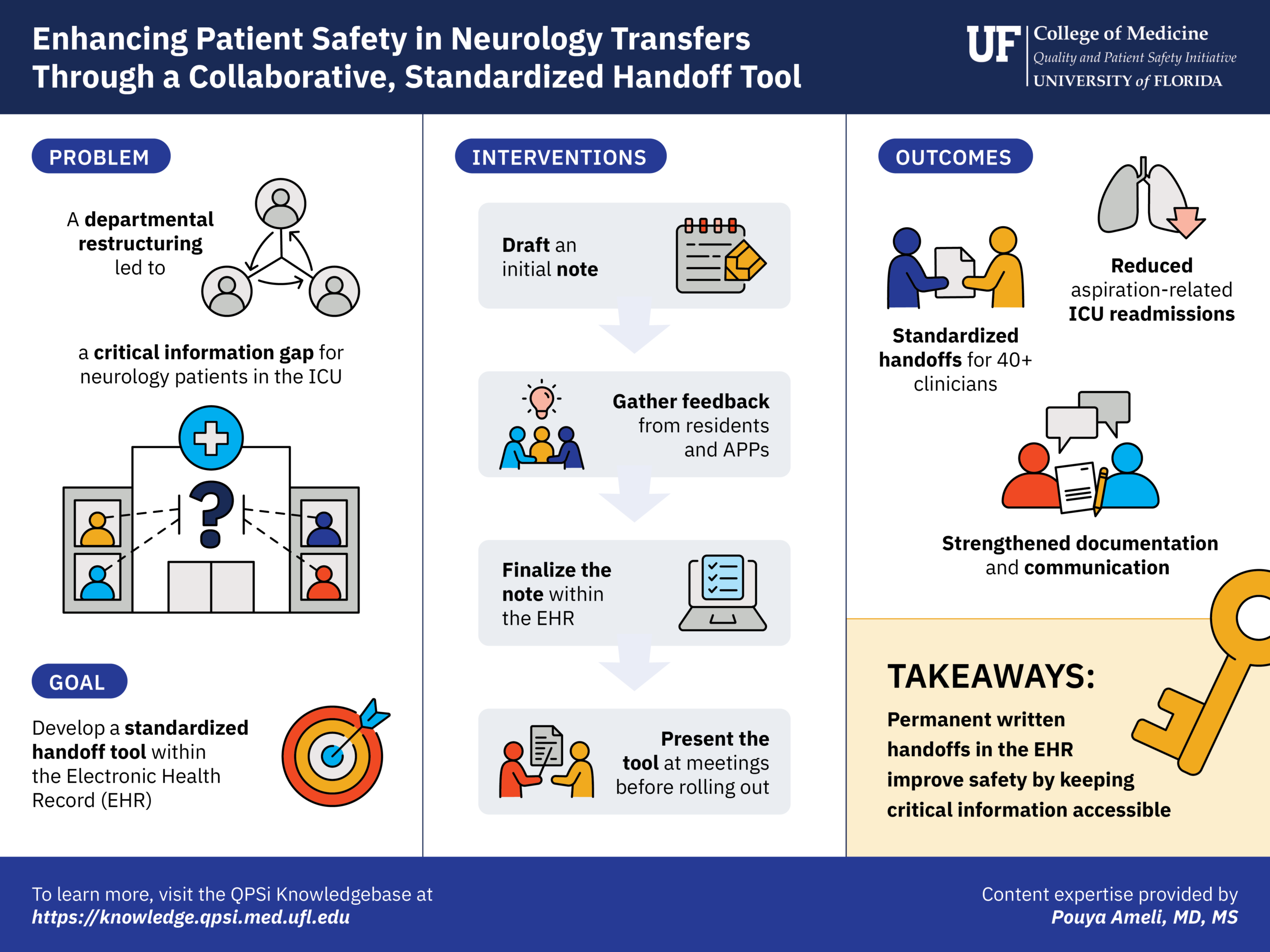
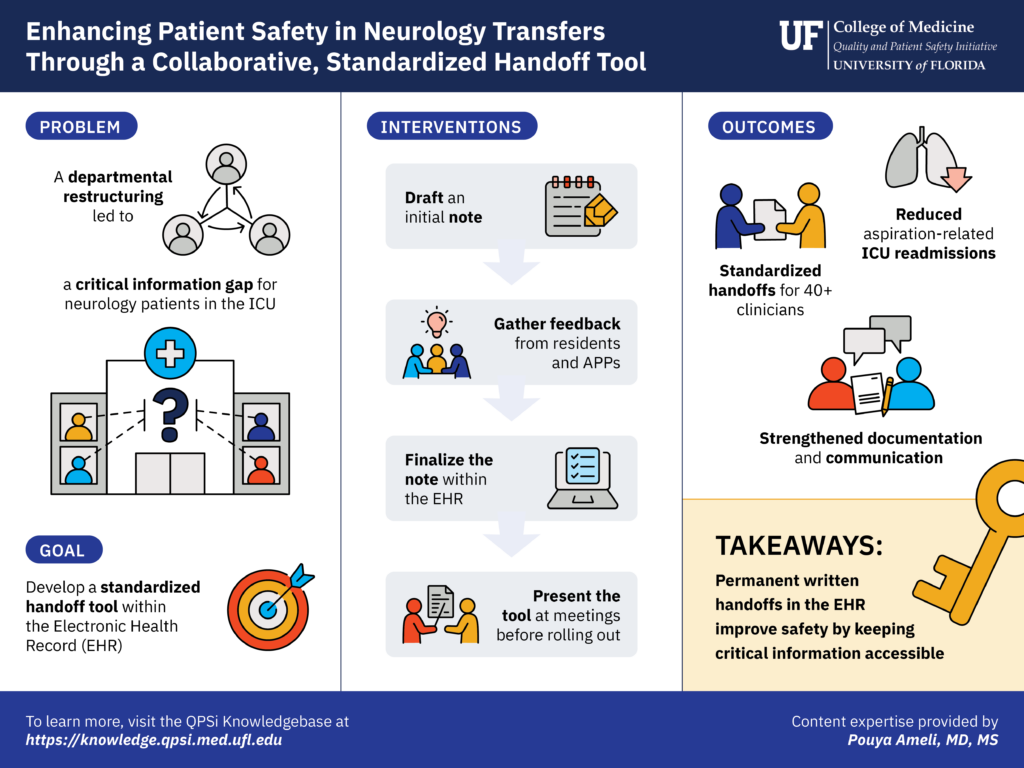
Image: EHR Tool Visual Summary
Case Summary
When a departmental restructuring separated the neurology ICU and general floor teams, critical patient information began falling through the cracks. This case study details how a physician-led, collaborative quality improvement initiative closed that gap — not through a costly IT overhaul, but by creatively leveraging tools already available within the EHR. The result was a practical, widely adopted handoff solution that improved communication, reduced preventable adverse events, and offered a replicable model for other services facing similar transitions.
Setting & Context
This initiative took place within the neurology service, spanning the Neurointensive Care Unit (Neuro ICU) and the general neurology floor. The project was led by a physician champion and co-developed with the primary end-users: neurology residents and Advanced Practice Providers. Together, these clinicians manage a complex patient population requiring careful, continuous coordination across care settings — making reliable transfer communication especially critical.
Problem & Aims
A departmental restructuring created an unintended but significant patient safety risk: the general neurology service no longer followed patients in the ICU, meaning the teams responsible for sending and receiving transferred patients had no standardized way to share critical clinical information. Informal conversations with ICU and floor clinicians confirmed that this gap was leading to miscommunication, inconsistent documentation, and preventable complications — including patients “bouncing back” to the ICU for issues that could have been anticipated and addressed during handoff.
The team set out to develop and implement a standardized, written handoff process embedded directly in the EHR, accessible to all members of the care team at any time. The aim was to replace unreliable verbal-only sign-outs with a structured, bidirectional transfer note that captured essential clinical priorities for both the sending and receiving teams, and that could be adopted quickly without reliance on lengthy IT development cycles.
QI Strategy & Changes
The team used a collaborative, iterative improvement approach spanning several months, with a physician champion leading development alongside frontline resident and APP stakeholders.
The process began with problem identification — informal conversations with ICU and floor clinicians to map the specific communication failures created by the restructuring. From there, the team agreed that a standardized written note within the EHR would be more reliable and accessible than verbal sign-outs alone.
The physician champion created an initial draft, which was then brought to resident and APP representatives in a series of meetings for feedback. Their input on clinical priorities and real-world workflow shaped meaningful refinements to the tool. Once finalized, the physician champion personally built the note as a smart phrase and smart list within the EHR, designing it to be easily populated from the daily progress note to minimize additional documentation burden.
The tool was designed to capture not just what was done, but why — documenting the nuanced clinical reasoning behind complex medication decisions for conditions like status epilepticus or autoimmune encephalitis. It explicitly recorded failed therapies to prevent the receiving team from repeating ineffective treatments, and included anticipatory guidance flagging ongoing risks such as tenuous respiratory status requiring careful airway management.
Before rollout, the tool was formally presented at resident and APP business meetings to explain its function and build institutional buy-in. The transfer note was then mandated for all patient transfers between the Neuro ICU and the general neurology floor.
Impacts & Outcomes
The standardized transfer note produced immediate and sustained improvements across the neurology service. While formal quantitative analysis is ongoing, qualitative outcomes were significant:
- Standardized communication across 40+ clinicians, aligning clinical priorities between the ICU and floor teams
- Marked reduction in preventable ICU readmissions, particularly aspiration events that had previously gone unaddressed during handoff
- Improved documentation culture — the tool reduced redundant effort and ensured critical information was consistently captured and accessible to the full care team
- Rapid deployment achieved without reliance on formal IT project cycles, demonstrating the potential of clinician-led EHR innovation
Practical Insight
The challenge: A structural change in your department has created a communication gap between care teams, increasing the risk of adverse events during patient transitions.
The aim: Develop a standardized, written handoff process that is embedded in existing workflows, easy to use, and adopted by frontline clinicians.
Tips for replication:
- Start with frontline input. Residents and APPs know where handoffs break down. Their early involvement shapes a tool that gets used.
- Use what’s already there. EHR smart phrases and smart lists can be built by a motivated clinician without an IT ticket — explore what your system supports.
- Design for the workflow, not the ideal. Link the handoff note to documentation clinicians are already completing (e.g., daily progress notes) to reduce friction.
- Secure buy-in before rollout. Presenting the tool at formal team meetings — explaining the “why” and the ease of use — accelerates adoption and reduces resistance.
- Don’t wait for perfect data. Qualitative signals like reduced bounce-backs and staff feedback are meaningful early indicators that justify continued refinement.
Common barrier: Clinicians may perceive a new documentation requirement as added burden.
Solution: Build the tool to auto-populate from existing notes, and demonstrate at rollout how it saves time by eliminating repeated verbal sign-outs.
Resources
The following resources support the principles demonstrated in this case study. Assets are organized by learning stage, from understanding the problem to implementing your own solution.
Case Study: Enhancing Patient Safety in Neurology Transfers Through a Collaborative, Standardized Handoff Tool
A nationwide neurology provider shortage pushed academic medical centers to restructure services — and at our institution, that restructuring created an unintended patient safety risk. In this video, the neurology team walks through how a critical information gap emerged during ICU-to-floor transfers, how a physician champion led a collaborative, user-centric response, and how a single EHR-embedded transfer note standardized communication for over 40 clinicians. The video highlights the tool’s key features — including documentation of failed therapies, nuanced clinical reasoning, and anticipatory guidance — and the immediate qualitative outcomes that followed, including a marked reduction in preventable ICU readmissions.
Transcript: Enhancing Patient Safety in Neurology Transfers Through a Collaborative, Standardized Handoff Tool
The field of neurology faces a nationwide provider shortage, creating immense pressure on academic medical centers to increase patient access.
In response, our institution restructured its services to open a new access clinic. While successful, this change introduced a new and serious patient safety risk—the general neurology team no longer followed their patients in the neuro ICU, as the team was busy staffing the new access clinic. Having the team not follow patients in the ICU was a way to decrease their workload as they facilitated the new clinic.
However, the change created a critical information gap during patient transfers that could compromise care. This case study is an example of what can be done within an EHR by a single clinician or small team, without needing to consult IT to create an EHR build.
The project was led by a physician champion. It was built around the frontline clinicians who would use the tool every day—neurology residents and advanced practice providers. Recognizing that a verbal-only handoff was insufficient, the group decided that a standardized written note embedded within the electronic health record was the most effective strategy to ensure clear, consistent, and accessible communication for the entire care team. The centerpiece of their strategy was the creation of a single comprehensive transfer note.
This bidirectional tool, built as an EHR smart phrase, was designed to function as a definitive handoff document for patients moving between the ICU and the general neurology floor. The tool prompted clinicians to document information that is frequently lost in transfers, but is critical for patient safety. It captured not just what was done, but why, detailing the nuanced decision-making behind complex medication choices for conditions like status epilepticus or autoimmune encephalitis.
A key feature was the explicit documentation of failed therapies. By clearly stating, for example, that a seizure medication like Keppra had already been tried and was ineffective, the note prevents the receiving team from losing valuable time by reinventing the wheel. The note also provided crucial anticipatory guidance. It highlighted ongoing risks such as a tenuous respiratory status requiring careful airway management, ensuring the receiving team was fully aware of the patient’s vulnerabilities and could tailor their care plan accordingly.
The results, though qualitative, were immediate and clear. The standardized note streamlined communication for a team of over 40 clinicians. Clinicians reported a significant reduction in patients bouncing back to the ICU for preventable complications like aspiration—a direct validation of the more effective and complete handoff process. Beyond the immediate safety improvements, the initiative showcased a powerful new model for quality improvement—rapid, clinician-led innovation.
By building the tool himself within the existing EHR framework, the physician champion was able to bypass traditional IT development cycles, proving that empowered clinicians can create and implement effective solutions with speed and precision. This case study underscores a fundamental principle in modern healthcare: that strategic collaboration with frontline users, combined with the intelligent integration of existing technology, can systematically enhance patient safety and create more resilient clinical workflows.
Visual Summary: EHR Tool
This downloadable infographic provides an at-a-glance overview of the problem, interventions, outcomes, and takeaways. Use it as a quick reference when planning a similar initiative.