
 Omjoy Ganesh, PhD, PharmD
  Liliana Bell, MHA, PMP
 What is a Project Charter?
Every successful quality improvement project needs a clear plan, but it’s easy for teams to get lost in undefined goals, leading to confusion and wasted effort. The project charter is the foundational document that prevents this. It serves as a formal agreement that defines the “why,” “what,” and “who” of your project, providing a single source of truth for your team, stakeholders, and leadership.
More than just a document, a charter is a versatile tool. It acts as a blueprint by defining your project’s scope to prevent scope creep. It’s a spotlight that illuminates risks early and highlights the intended benefits for patients. As a game plan, it unites your team around a shared vision and clarifies roles. Finally, it’s a bridge to organizational resources, clearly communicating your needs to support groups and ensuring your project has what it needs to succeed.
Resources
The video and template below provide the guidance and tools you need to create an effective project charter for your next QI initiative.
Developing Your Project Charter
Watch this video to learn why a project charter is essential for quality improvement. It explains four key functions of a charter and shows how it empowers your team to deliver measurable improvements in patient care.
Transcript: Developing Your Project Charter
A project charter is more than a document. It’s a versatile and essential tool for Quality Improvement, or QI. Since it serves so many functions, you can think of it in multiple ways. Let’s explore why a project charter is vital for all QI initiatives and how it empowers your team and organization.
Think of the charter as your blueprint. Without it, you risk building without instructions, leading to confusion, wasted effort, and missed opportunities.
Your charter defines the reasons for undertaking the project, outlines your objectives and constraints, and gives directions about the solutions you’ll pursue. It also identifies your main stakeholders and clarifies what’s in scope, and just as importantly, what’s out of scope.
By setting these boundaries early, your team can stay on target and avoid the distraction of side projects or scope creep.
A good charter is also a spotlight. It reveals risks early so you can address them before they derail your work. It also identifies your target benefits, giving everyone a clear vision of the impact you want to achieve for patients, the care team, and the organization.
This clarity not only inspires action, it also helps leadership understand the value of your work and how it aligns with broader hospital goals.
The charter is also a game plan. After all, key projects are team sports. Developing your charter with your QI project team builds a shared vision and ensures everyone understands the goals, timelines, and roles.
Because it’s created collaboratively, it becomes a living document, one that can evolve with your project and keep everyone aligned from start to finish.
Finally, a well-crafted charter is also a bridge to your hospital’s QI and analytics groups. It tells them exactly what your project is about and what is needed to offer targeted support, whether it’s analytics, coaching, or removing barriers, all this so your team can focus on improving care.
Put simply, a project charter helps explain why you need resources from your health system. In short, the project charter communicates your scope, aims, challenges, and opportunities in one place. It’s your blueprint, your spotlight, your game plan, and a bridge to connect with resources.
Remember, a project charter helps your team and organization deliver real, measurable improvements in patient care.
Project Charter Template
The project charter helps your team create a comprehensive, actionable plan. This collaborative document serves as a roadmap to align your team, define the scope, and outline your strategy before you begin testing changes.
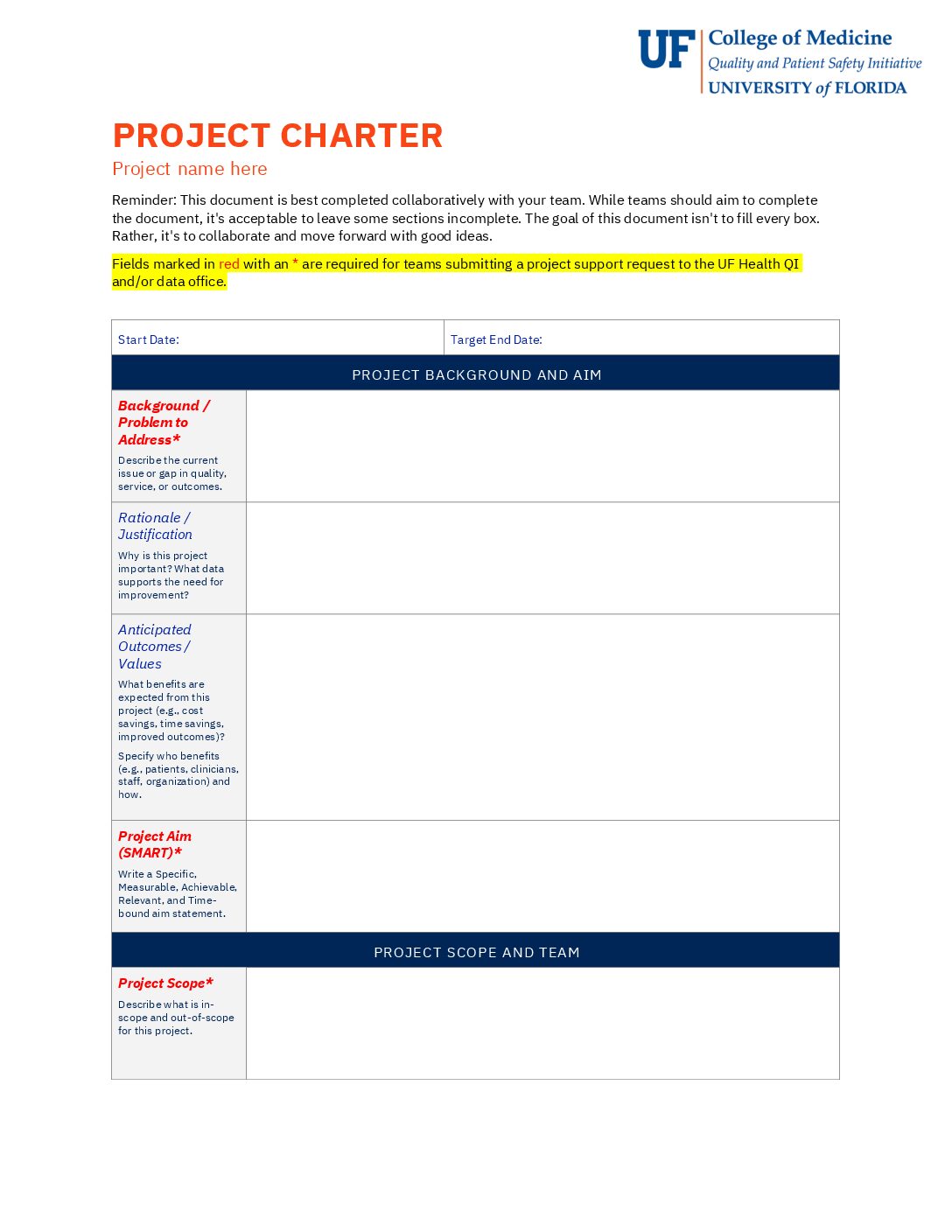
Download the Project Charter Template
Use this fillable template to create a comprehensive project charter for your QI project. It provides a structured format to document all essential components, including:
- A description of the problem, the project’s rationale, and a specific, measurable, achievable, relevant, and time-bound (SMART) aim statement.
- The principal outcome, process, and balancing measures to track progress and determine if a change is an improvement.
- A list of proposed change ideas, a summary of the root cause analysis, and an outline for the initial Plan-Do-Study-Act (PDSA) test cycles.
- Identification of potential barriers or risks, along with key project milestones and deadlines.