
 Barbara Paulison, PharmD
Medication Errors in Clinical Practice
Medication errors are any preventable event that may cause or lead to inappropriate medication use or patient harm — a definition broad enough to include errors that harm patients, errors that reach patients without causing harm, and near misses that are caught before any patient contact. That breadth is intentional: every type of error reveals something about where the system has a gap.
Most errors do not originate with careless individuals. They originate in systems that were not designed to catch what humans, under pressure, will inevitably miss. Ordering errors alone account for roughly half of all medication errors, but vulnerabilities exist at every stage: in how orders are transcribed and communicated, how medications are dispensed and verified, how administration is performed, and how patient response is monitored. Recognizing those vulnerabilities, and knowing the safeguards designed to address them, is foundational knowledge for every member of a clinical team.
The RaDonda Vaught Case
In December 2017, RaDonda Vaught, a registered nurse at Vanderbilt University Medical Center, was asked to administer Versed — a sedative — to 75-year-old patient Charlene Murphey before a PET scan. Unable to locate the medication in the dispensing cabinet, Vaught used an override function and retrieved vecuronium, a neuromuscular blocking agent, instead. No barcode scanner was available at the point of administration to catch the error. Murphey was found unresponsive shortly after and did not survive. In 2022, Vaught was convicted of criminally negligent homicide and gross neglect of an impaired adult — one of the most closely watched criminal prosecutions of a clinician in U.S. history. The American Nurses Association warned that the verdict set a dangerous precedent of “criminalizing the honest reporting of mistakes,” with significant implications for the culture of transparency that patient safety depends on.
What the case exposed was not the failure of one nurse, but the convergence of multiple system vulnerabilities: a medication override workflow that made a dangerous substitution possible, the absence of barcode verification at the point of care, workload pressures, and an organizational culture that did not adequately support safe practice. Vaught herself said, “I do not work in a vacuum. I work in a healthcare system.” The resources below build that understanding through a case-based series that follows a single insulin order from prescribing to patient bedside.
Resources
This five-module video series is presented by Barbara Paulison, Pharm.D., Clinical Pharmacy Specialist in Medication Safety at UF Health. Dr. Paulison guides learners through the full arc of the medication-use process — using a single patient case to show how errors enter, accumulate, and can be stopped. The series is accompanied by a downloadable reference card, designed for use at the point of care.
Module 1 – What Are Medication Errors and Where Do They Happen?
Dr. Paulison opens the series by defining medication errors, introducing the five stages of the medication-use process, and framing why system design — not individual fault — is the foundation of error prevention.
Transcript: What Are Medication Errors and Where Do They Happen?
Hi, I’m Barbara Paulison, a clinical pharmacy specialist dedicated to medication safety at UF Health. When we talk about medication errors, the instinct is to think about the individual who made the mistake. Most medication errors are not the result of careless people — they’re the result of systems that weren’t designed to catch human mistakes before they reach patients. That framing matters, because it changes what we do about it.
A medication error is any preventable event that may cause or lead to inappropriate medication use or patient harm. That definition is broad on purpose. It includes errors that reach the patient and cause harm, errors that reach the patient but don’t cause harm, and errors that are caught before the patient ever sees them — near misses. All of them matter, because all of them tell us something about where the system has a gap.
To make this concrete, meet Mr. H — a 68-year-old man admitted for a lower extremity infection, with type two diabetes managed on insulin and several other medications. In this series, we’ll follow his insulin order from the time it’s written to the moment it’s administered — and see how errors can enter the process at almost every stage along the way.
The medication use process has five key stages. Ordering and prescribing. Transcription and order communication. Dispensing. Administration and monitoring. Ordering errors are the most common, accounting for roughly 50% of all medication errors. Wrong medication. Wrong dose. Wrong root. Wrong frequency transcription errors follow at around 15 to 30% and include unsafe abbreviations, unknown acronyms, and incomplete documentation.
Dispensing errors involve the wrong drug, wrong strength, or wrong patient administration errors. Wrong dose. Wrong route. Wrong patient. Errors of omission are where the process meets the patient directly, and monitoring errors are the failures to act. Missed assessments. Overlooked lab values. Doses never reconciled against the patient’s current clinical status.
For Mr. H, his insulin order is written and enters the system. It looks routine. In module two, we’re going to follow it forward — and watch where the vulnerabilities start to appear.
Module 2 – Contributing Factors and Error Types
Following a single insulin order through the medication-use process, Dr. Paulison identifies how errors and contributing factors accumulate across multiple stages — and why a single point of failure is rarely the whole story.
Transcript: Contributing Factors and Error Types
Let’s look at potential errors and conditions that give rise to them. Ordering errors are the most common. Mr. H’s order reads “10 U regular insulin.” “U” for units is a well-documented error-prone abbreviation — written quickly, it reads as a zero. Ten units becomes 100. The order moves forward.
At the transcription stage, a note from his outpatient provider documenting a recent insulin dose reduction didn’t make it into the active order set. The order now reflects his previous higher dose, not where he is today. This is an incomplete patient information error, a common contributing factor.
At dispensing the order looks routine. The pharmacist is managing a high-volume queue. The insulin is released without the reconciliation gap being flagged. Workload and interruptions — two of the most significant contributing factors in medication errors — are making a significant impact here. Not because anyone is being careless, but because the system placed the entire burden of detection on an individual who didn’t have the full picture.
Administration. The nurse scans Mr. H’s wristband and the insulin vial. The barcode system clears both. And this is where the monitoring error enters. His blood glucose hasn’t been checked in the required window before administration. That’s not a technology failure. Barcode scanning worked exactly as designed.
It’s a workflow failure. The pre-administration check wasn’t built into the process in a way that made it hard to skip. So what conditions allowed errors to accumulate across four stages? High workload and interruptions, incomplete information at reconciliation, and unapproved abbreviation that should not have been used.
A communication gap between outpatient and inpatient teams, and a workflow that didn’t enforce a critical monitoring step.
None of these are about bad intentions. It’s about a system that wasn’t designed to catch what people under pressure will inevitably miss. In modules three and four, we’ll look at the safeguards that address each one.
Module 3 – Safeguards: Standardization and Verification
This video covers the first layer of defense against medication errors: the ordering and verification practices every clinical team member can apply immediately. Dr. Paulison walks through concrete strategies that address the vulnerabilities introduced in the previous video.
Transcript: Safeguards: Standardization and Verification
In this module we address the first layer of defense: standardization and verification at ordering and administration. Let’s start with the order itself. Some of the most preventable medication errors don’t come from complex clinical decisions. They come from how orders are written. Certain abbreviations are so reliably misread that they should never appear in a medication order.
“U” for units is the clearest example — written quickly, it can read as a zero, turning ten units into a hundred. Write out the word units in full every time. A trailing zero — “1.0 mg” instead of “1 mg” — risks a tenfold overdose if the decimal is missed. And “.5 mg” instead of “0.5 mg” creates the same problem in reverse. No trailing zeros. Always use a leading zero. “QD” can be misread as “QID.” “MS” can mean morphine sulfate or magnesium sulfate. Neither should be used in an order. When a verbal order is unavoidable, require a full read-back, spelling out sound-alike drug names and expressing numbers as single digits to confirm accurate receipt.
For Mr. H, writing “10 units regular insulin” instead of “10 U” removes the first vulnerability in his medication journey entirely. The second strategy is managing look-alike, sound-alike, LASA medications. Humalog and Humulin. Hydroxyzine and hydralazine. Tall man lettering highlights the distinguishing characters in similar names.
HumaLOG versus HumuLIN. HydrOXYzine versus hydrALAzine. It draws the eye to exactly the part of the name that differentiates the two drugs. Now to verification, the five rights—right patient, drug, dose, route and time—are most useful when treated as five genuine clinical questions, not a sequence to move through.
Right dose for Mr. H doesn’t just mean matching the order, it means asking whether this dose is appropriate for where this patient is today. That’s the question. His reconciliation gap made impossible to answer correctly. And right time, for insulin, means confirming that blood glucose monitoring is complete before administration.
These aren’t complicated interventions. Avoiding error prone abbreviations, applying look-alike, sound-alike strategies, and using the five rights as a real verification framework are practices every clinical team member can apply on the next shift. In module four, we’ll look at the technology layer that sits alongside them and where that technology has its own limits.
Module 4 – Safeguards: Technology and Independent Checks
Dr. Paulison examines the technology tools that support safe medication practice — and is equally clear about where their protection ends. The patient case from earlier in the series reaches its resolution here.
Transcript: Safeguards: Technology and Independent Checks
In this module, we’ll cover the technology layer and what it does and doesn’t do. Computerized prescriber order entry — CPOE — eliminates handwriting and transcription errors and enables real-time clinical decision support: drug-drug interaction alerts, allergy flags, and dose range checks. The limitation is alert fatigue.
When clinical team members receive too many low-priority alerts, they begin overriding them reflexively — including the ones that matter. Technology can only protect you if you’re engaging with it. Barcode medication administration confirms patient and drug identity at the point of care and consistently reduces administration errors, but it cannot confirm clinical appropriateness.
When the nurse scanned Mr. H’s wristband and his insulin vial both cleared, the system did exactly what it was designed to do. What it couldn’t tell her was whether the dose was right for where Mr. H was that day, because that required clinical judgment, a current blood glucose and a reconciled medication history.
The technology passed. The system hadn’t given her what she needed to make the call. Smart infusion pumps with dose error reduction software set parameters for maximum and minimum infusion rates and flagged deviations. One of the most effective safeguards for high-alert IV medications. Their limitation is the same as any technology overrides can circumvent the protection they provide, and drug libraries must be accurate and kept current to remain useful.
The principle across all three is consistent. They are layers of defense, not substitutes for a thinking clinical team member. They reduce the probability of certain errors reaching patients. They do not replace clinical review or reliable workflows. Which brings us to the safeguard that requires no technology at all.
The independent double check — a second clinical team member independently verifies a calculation, dose, or preparation without being shown the first person’s answer. That last part is what makes it independent. Showing someone your work and asking them to confirm is a delayed self-check, and it is significantly less reliable.
Independent double checks are resource-intensive, so they’re most valuable for high-alert medications and complex IV preparations — exactly where the margin for error is smallest. Before we close, the nurse paused before administering Mr. H’s insulin. She checked his blood glucose. It came back lower than expected.
She held the dose and called the prescriber. The reconciliation gap was caught. No harm reached, Mr. H. That’s the best version of how this ends. In module five, we’ll ask what happens when it doesn’t — and what every clinical team member’s responsibility is when an error occurs or nearly occurs.
Module 5 – High-Risk Medications, Reporting, and the QI Connection
Picking up where the previous video leaves off, Dr. Paulison addresses what happens when errors aren’t caught — and what every clinical team member is responsible for when they occur or nearly occur.
Transcript: High-Risk Medications, Reporting, and the QI Connection
In the previous module, the nurse caught the error and no harm reached Mr. H. Now let’s ask the harder question: what if she hadn’t paused?
Mr. H receives the dose, his blood glucose already lower than the team realized, drops further, he becomes diaphoretic and confused. By the time anyone recognizes what’s happening, he’s hypoglycemic and requires intervention.
Three points in the system failed to catch an error that was correctable at every stage. This brings us to high-alert medications — and insulin is one of them. High-alert medications are not necessarily more prone to error than other medications. What distinguishes them is the severity of harm those errors cause when they do occur.
Hypoglycemic anticoagulants. Opioids. Neuromuscular blocking agents. Chemotherapy — these are medications where an error can escalate quickly and seriously. Special populations amplify these risks, especially pediatrics. Children are uniquely vulnerable because dosing is almost entirely weight-based, requiring multi-step calculations where a misplaced decimal point leads to a tenfold overdose — and developing organ systems and limited ability to communicate early symptoms mean errors escalate far more rapidly.
The RaDonda Vaught case is a stark example: vecuronium dispensed instead of versed, with fatal consequences. For high-alert medications, standard safeguards aren’t enough on their own. They require sequestered storage, standardized order sets, auxiliary labels, and independent double checks built into the workflow as non-negotiable steps.
When an error occurs — or nearly occurs — we report it. ISMP, the FDA, and UF Health all have reporting systems. Error reporting isn’t punitive. It identifies trends, detects system issues, and generates the data needed to develop risk reduction strategies. A near miss is just as reportable as an adverse event — because it reveals exactly where the system is vulnerable before a patient is harmed.
Just Culture is the framework that makes honest reporting possible. It distinguishes between human error, which is unintentional; at-risk behavior, where risk exists but isn’t recognized; and reckless behavior, where substantial risk is known and ignored. Most medication errors fall into the first two categories.
The nurse who almost administered Mr. H’s insulin without a blood glucose check wasn’t reckless. She was working in a system that hadn’t enforced the monitoring requirement. The response to that isn’t blame. It’s a root cause analysis to understand what failed, and an FMEA to identify prospectively where similar failures could occur.
Errors are not isolated clinical events. They are data about how a system is performing — and every clinical team member who reports what they see, asks why it happened, and helps design a better process, is doing quality improvement work.
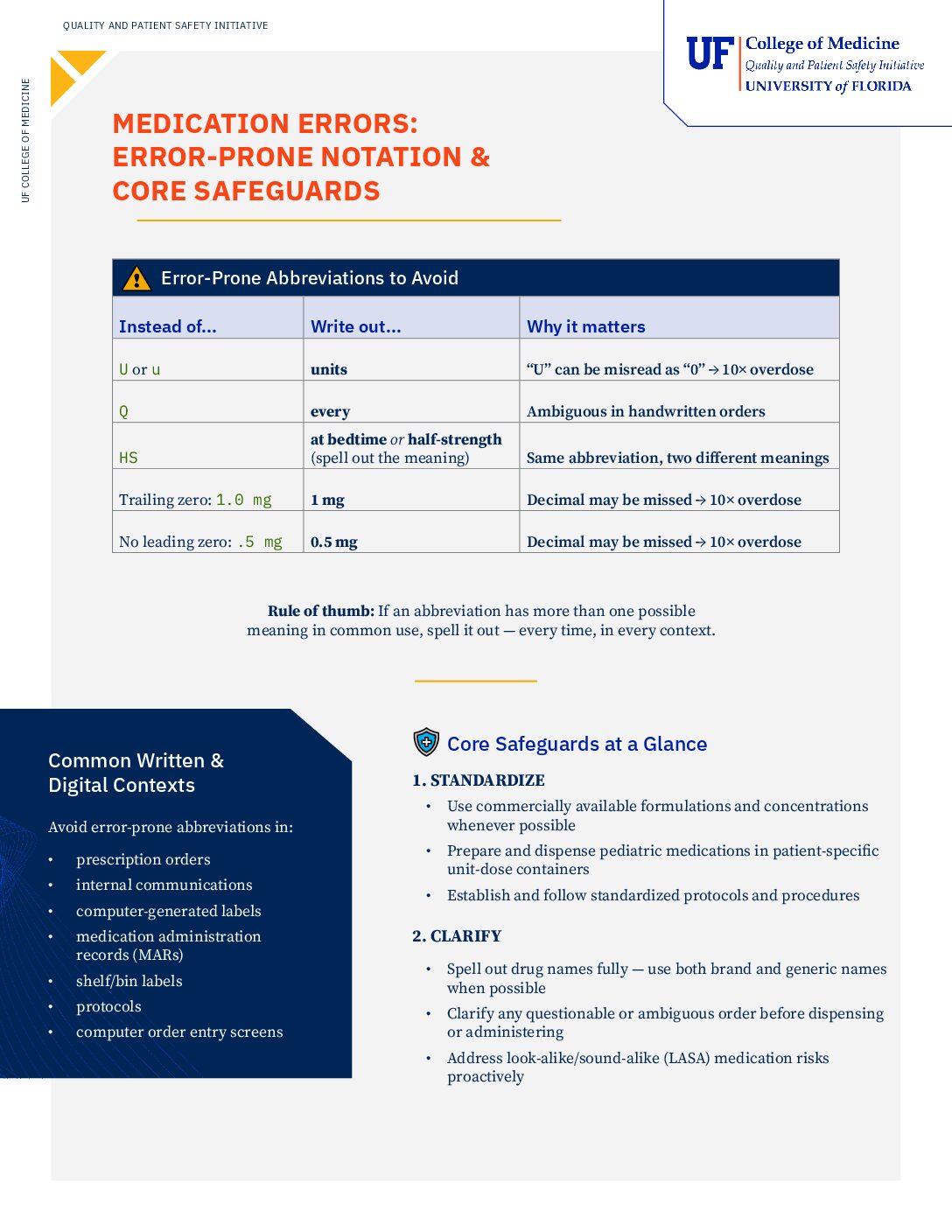
Reference Card: Error-Prone Notation & Core Safeguards
This quick-reference card distills core safety practices into a durable, scannable format for use at the point of care. It covers the error-prone abbreviations clinicians should never use in orders, labels, MARs, or protocols — alongside the four core safeguard categories: Standardize, Clarify, Verify, and Use Technology Thoughtfully.
Download and keep this card accessible during clinical rotations as a companion to the video series. Return to it when writing orders, verifying medications, or orienting to a new care environment.
Download Error-Prone Notation & Core Safeguards
What’s inside:
- A table of error-prone abbreviations explaining why each creates risk, plus tips for ambiguous notation and a listing of written and digital contexts where safe notation applies.
- An overview on safeguards, including:
- Standardized formulations
- LASA medication risks
- Pediatric weight-based dosing requirements
- A reminder that technology reduces — but does not replace — clinical review.