

 Mark Clarke, MD
 Shifting from Volume to Value
For decades, the American healthcare system operated on a fee-for-service model that compensated providers for the quantity of services delivered. This approach has led to escalating costs without a corresponding improvement in patient health, creating a system that rewards activity over effectiveness. The result is higher spending for poorer outcomes compared to other developed nations.
Value-based care represents a fundamental shift away from that paradigm. Instead of paying for volume, this model rewards the quality and effectiveness of care, re-aligning financial incentives with a patient’s best interest. The central idea is captured in a simple equation: Value = Health Outcomes ÷ Cost. By focusing on collaborative, preventative, and coordinated care, this approach aims to achieve the quintuple aim: improving health outcomes, enhancing the patient experience, managing costs, ensuring team satisfaction, and advancing health equity.
To put these principles into practice, healthcare systems use specific frameworks to measure and reward value. One of the most significant of these is the Merit-based Incentive Payment System (MIPS), which provides a concrete structure for translating quality care into tangible results.
Resources
The following resources are designed to build your understanding of value-based care from the foundational concept to practical application. Start with the first video to grasp the core principles, then proceed to the second to learn about MIPS, a key program that puts these ideas into action.
Value-Based Care: Why It Matters to Clinicians and Healthcare Staff
This video explains the fundamental paradigm shift from a fee-for-service system to a model that rewards quality and effectiveness. It defines the core principles of value-based care, including the value equation and the pursuit of the quintuple aim, showing how it realigns the focus of healthcare back to improving patient well-being.
MIPS: Merit-based Incentive Payment System
This video introduces the Merit-based Incentive Payment System (MIPS) as a key driver of value-based care. It breaks down the four performance categories—Quality, Cost, Promoting Interoperability, and Improvement Activities—and explains how a clinician’s final score creates a powerful financial incentive for delivering high-quality, cost-efficient care. The video also highlights how the data-driven nature of MIPS compels practices to identify gaps and implement targeted quality improvement initiatives.
Tips for Starting a Value-Based Care Project
This handout breaks down the process of starting a value-based care project into four key steps:
- Lay the Foundation: Learn how to build team buy-in through education on the “why” behind value-based care.
- Develop a Collaborative Roadmap: Discover how to set concrete goals and empower your team by involving them in the planning process.
- Measure What Matters: Understand the key metrics to track, including Quality, Utilization, Cost, and Patient-Centered data.
- Lead the Change: See how to maintain momentum through continuous assessment, adaptation, and recognition of success.

Download the Tips for Starting a Value-Based Care Project
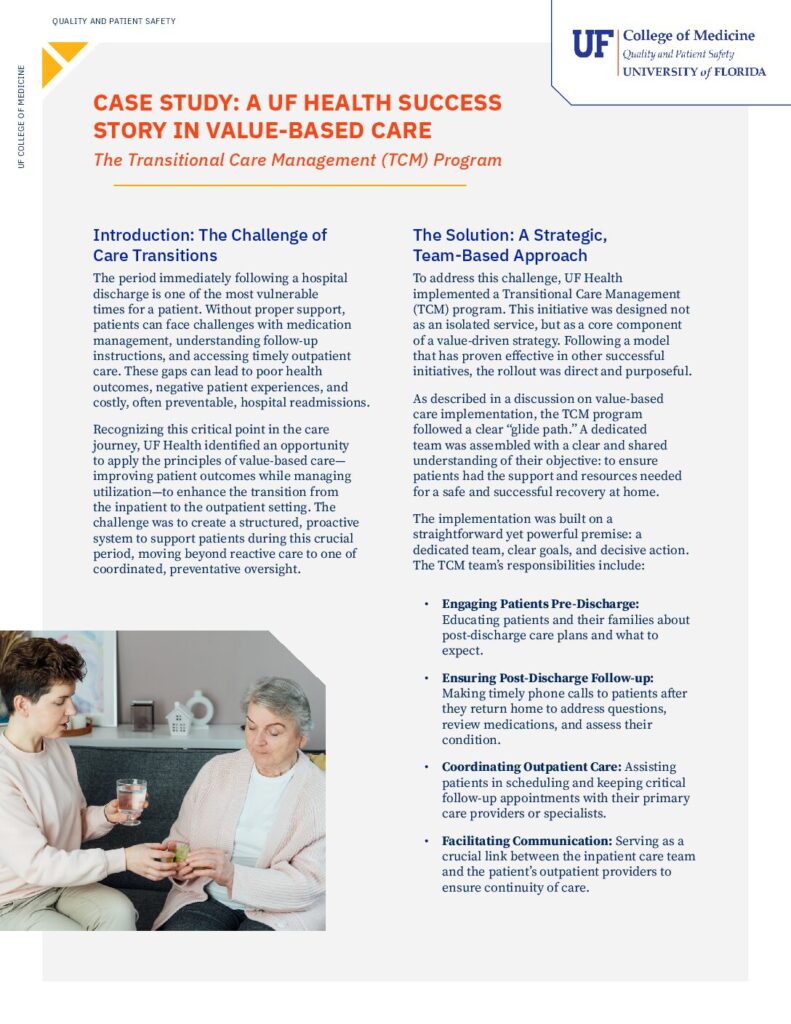
Case Study: A UF Health Success Story in Value-Based Care
This case study explores UF Health’s Transitional Care Management (TCM) program, a real-world example of value-based care in action. It covers:
- The Challenge: It identifies the vulnerable period for patients after hospital discharge, which can lead to poor outcomes and preventable readmissions.
- The Solution: It details how a dedicated, team-based TCM program was implemented to proactively support patients transitioning from inpatient to outpatient settings.
- The Results: It shows how this focus on preventing adverse events improved patient outcomes and created a powerful proof of concept for value-driven projects at UF Health.