
 Mark Clarke, MD
 Shifting from Volume to Value
For decades, the American healthcare system operated on a fee-for-service model that compensated providers for the quantity of services delivered. This approach has led to escalating costs without a corresponding improvement in patient health, creating a system that rewards activity over effectiveness. The result is higher spending for poorer outcomes compared to other developed nations.
Value-based care represents a fundamental shift away from that paradigm. Instead of paying for volume, this model rewards the quality and effectiveness of care, re-aligning financial incentives with a patient’s best interest. The central idea is captured in a simple equation: Value = Health Outcomes ÷ Cost. By focusing on collaborative, preventative, and coordinated care, this approach aims to achieve the quintuple aim: improving health outcomes, enhancing the patient experience, managing costs, ensuring team satisfaction, and advancing health equity.
To put these principles into practice, healthcare systems use specific frameworks to measure and reward value. One of the most significant of these is the Merit-based Incentive Payment System (MIPS), which provides a concrete structure for translating quality care into tangible results.
Resources
The following resources are designed to build your understanding of value-based care from foundational concepts to practical application. The collection functions as a guided learning path: begin with the videos to grasp the framework, then use the handouts to see how to put those ideas into action.
Value-Based Care: Why It Matters to Clinicians and Healthcare Staff
This video explains the fundamental paradigm shift from a fee-for-service system to a model that rewards quality and effectiveness. It defines the core principles of value-based care, including the value equation and the pursuit of the quintuple aim, showing how it realigns the focus of healthcare back to improving patient well-being.
Transcript: Value-Based Care: Why It Matters to Clinicians and Healthcare Staff
For decades, the healthcare system has largely operated on a fee-for-service model. In this system, providers are paid for the quantity of services they deliver– every test, every procedure, and every appointment.
But the model is being phased out, as this approach has led to rising costs without a guaranteed improvement in patient health. In fact, while the US spends nearly twice as much per person on health care as other wealthy countries, we often see some of the worst outcomes.
Value-based care represents a fundamental shift in this paradigm. Value-based care is simply good quality care. It’s patient-centered, outcome-centered, and cost-conscious. Instead of rewarding the volume of care, which incentivizes unnecessary services, value-based care rewards the quality and effectiveness of that care.
The central idea is to improve patient health outcomes while managing costs. Success is measured not by how many treatments are provided, but by how well a patient recovers and maintains their health.
The core principle is an equation.
Value equals health outcomes divided by cost.
To achieve this, providers are encouraged to work collaboratively within a health network. Teams of doctors, nurses, and specialists coordinate to manage a patient’s overall well-being.
The focus moves toward preventative care education for the population and the proactive and coordinated management of chronic conditions, aiming to keep people healthy and reduce the need for expensive interventions.
In a value-based model, health care services are often compensated based on specific patient outcomes. This could mean fewer 30-day hospital readmissions, lower infection and mortality rates, and higher patient satisfaction. The financial incentives are aligned with the patient’s best interests.
Cost-saving measures are achieved with strategies such as negotiations with payers to increase coverage of reimbursement investments focused on needs, and achieving better price negotiations and risk-sharing agreements with suppliers.
Ultimately, the goal is to create a health care system that is more effective, affordable, and centered on the patient. It’s about achieving the quintuple aim– improving health outcomes, enhancing patient experiences, managing resources effectively, ensuring team satisfaction, and advancing health equity.
It’s a transition from pain for activity to pain for results– realigning the entire focus of healthcare back to the fundamental reason many enter medicine in the first place.
MIPS: Merit-based Incentive Payment System
This video introduces the Merit-based Incentive Payment System (MIPS) as a key driver of value-based care. It breaks down the four performance categories—Quality, Cost, Promoting Interoperability, and Improvement Activities—and explains how a clinician’s final score creates a powerful financial incentive for delivering high-quality, cost-efficient care. The video also highlights how the data-driven nature of MIPS compels practices to identify gaps and implement targeted quality improvement initiatives.
Transcript: MIPS: Merit-based Incentive Payment System
As health care moves from paying for volume to paying for value, the Merit-based Incentive Payment System, or MIPS, has emerged as a key driver of this change, as one of the two tracks under the Quality Payment Program from the Centers for Medicare and Medicaid Services.
MIPS is designed to link Medicare payments to the quality and cost-efficiency of care provided. The program functions by measuring eligible clinicians across four distinct performance categories– quality, cost, promoting interoperability, and improvement activities.
Quality focuses on patient outcomes and adherence to clinical best practices. Cost evaluates the overall expense of care during the year.
Promoting interoperability assesses the use of certified electronic health record technology, emphasizing patient engagement and information exchange.
Finally, improvement activities reward efforts to enhance care processes, patient engagement, and access to care.
Participation requires the collection of data for these categories throughout a performance year. This data is then submitted to CMS, which calculates a final MIPS score from 0 to 100.
This score directly determines a clinician’s future Medicare payment adjustments. High performers can receive a positive payment adjustment, while low performers may face a penalty, creating a powerful financial incentive to excel.
Therefore, accurate and thorough data reporting is fundamental to successful participation. This structure inherently influences quality improvement in patient safety.
By requiring the thorough tracking of specific metrics such as readmission rates, infection control, or management of chronic diseases, MIPS compels clinical practices to look critically at their own performance.
The process of measurement shines a light on potential gaps in care. This data-driven insight becomes the foundation for targeted quality improvement initiatives, encouraging practices to adopt safer protocols, streamline care coordination, and ultimately improve patient outcomes.
The primary benefit of MIPS is its ability to provide a structured framework for enhancing patient care, while creating a potential for increased reimbursement.
It encourages a culture of continuous improvement where data is used not just for reporting but for meaningful change.
However, the program presents challenges. Its complexity and annually changing rules can create a significant administrative burden. The resources required for tracking, analyzing, and reporting data can be substantial for any practice.
To navigate these challenges and succeed, best practices for implementation are crucial. It begins with educating the entire clinical team on the program’s goals.
From there, practices should engage the team in setting concrete, measurable objectives. Rather than trying to fix everything at once, they should use their performance data to identify a few key areas for focused improvement.
Establishing a continuous cycle of assessment and adjustment is vital.
By regularly reviewing progress and celebrating successes, practices can embed the principles of quality improvement into their daily operations, turning regulatory requirements into a genuine opportunity to deliver better, safer, and more effective care.
Tips for Starting a Value-Based Care Project
The attached guide provides a strategic roadmap for clinical teams and leaders transitioning to a value-based care model, which shifts the healthcare focus from service volume to patient outcomes and cost-effectiveness. Because this transition requires a fundamental change in mindset rather than just new protocols, the guide emphasizes the importance of intentional planning, collaborative team engagement, and continuous assessment to ensure long-term success.

Download the Tips Guide
- Lay the Foundation: Learn how to build team buy-in through education on the “why” behind value-based care.
- Develop a Collaborative Roadmap: Discover how to set concrete goals and empower your team by involving them in the planning process.
- Measure What Matters: Understand the key metrics to track, focusing on Quality, Utilization, Cost, and Patient-Centered data.
- Lead the Change: See how to maintain momentum through continuous assessment, adaptation, and recognition of success.
Case Study: A UF Health Success Story in Value-Based Care
The UF Health Transitional Care Management (TCM) program represents a successful application of value-based care, addressing the vulnerable period immediately following a hospital discharge to prevent adverse events and costly readmissions. By utilizing a dedicated, team-based approach, the program proactively supports patients through pre-discharge education, timely follow-up calls, and seamless coordination of outpatient appointments.
This structured initiative bridges the communication gap between inpatient and outpatient providers, ensuring a safer recovery at home for the patient. Ultimately, the TCM program demonstrates that a clear vision, an empowered collaborative team, and focused, preventative action can fundamentally improve patient transitions and deliver high-quality, value-driven health outcomes.
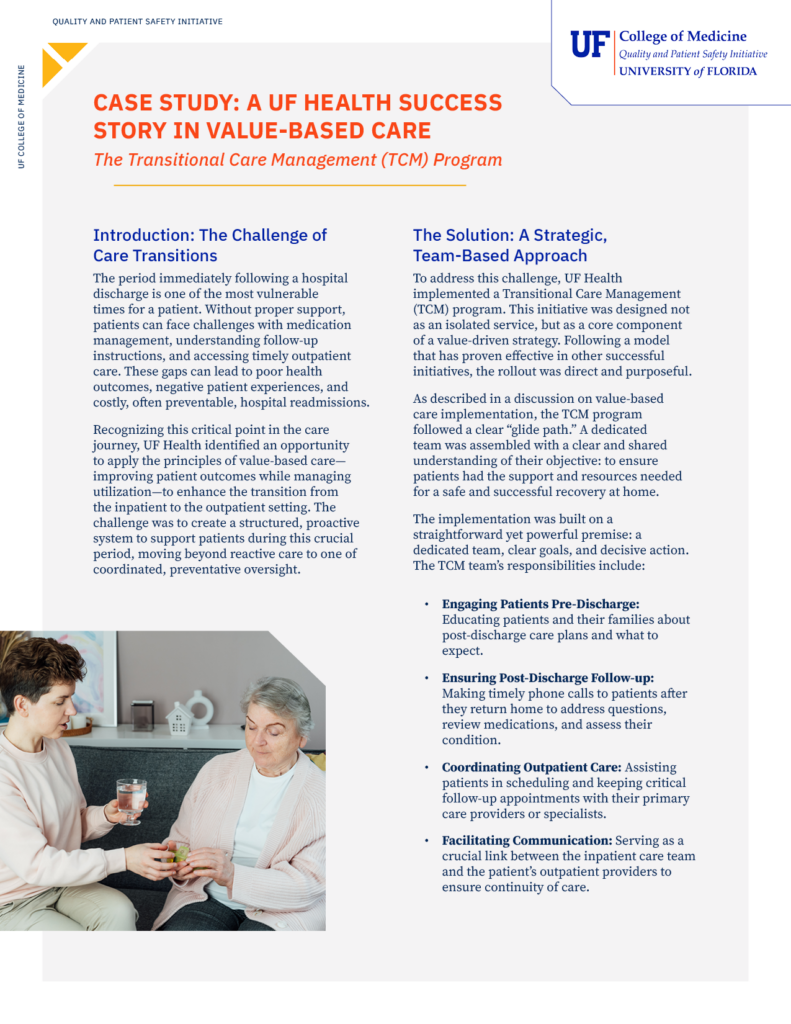
Download the Value-Based Care Case Study
- The Challenge: Patients’ most vulnerable period is after hospital discharge, which can lead to poor outcomes and preventable readmissions.
- The Solution: A dedicated, team-based TCM program was implemented to proactively support patients transitioning from inpatient to outpatient settings.
- The Results: Patient outcomes improved and a powerful proof of concept was created for value-driven projects at UF Health.