
 Paige Barker, MD
  Carrie Lagasse, PharmD
  Kent Mathias, MD
  Cameron Smith, MD, PhD
 Buprenorphine Prescribing at UF Health
Buprenorphine is a vital therapy for managing both Opioid Use Disorder (OUD) and acute pain, offering a potentially safer alternative to full agonist opioids due to its ceiling effect on respiratory depression. Historically, prescribing buprenorphine for OUD was limited by federal regulations and, more recently, by institutional restrictions at UF Health that limited its use to consulting services.
To align with contemporary practice and expand access to this important medication, the UF Health Pharmacy and Therapeutics (P&T) Committee has removed all prescribing restrictions for sublingual buprenorphine. Any provider with Schedule III authority—including physicians, physician extenders, and housestaff—can now order buprenorphine for inpatient use. This applies to initiating therapy for OUD or pain as well as continuing a patient’s home regimen. While this change empowers more clinicians to use this tool, it is crucial to understand its nuances, such as the risk of precipitating withdrawal, and to ensure adequate follow-up upon discharge.
Resources
The resources below provide essential information on the new prescribing guidelines and foundational knowledge about buprenorphine to support you in using this therapy safely and effectively.
Buprenorphine Formulary Change
Watch this video to understand the recent, important changes to buprenorphine prescribing policy at UF Health. It explains the removal of previous restrictions and clarifies which providers now have the authority to prescribe buprenorphine for inpatient use, empowering broader access to this critical therapy.
Transcript: Buprenorphine Formulary Change
In specific patients, buprenorphine may be considered a safer opioid alternative used for both opioid use disorder and pain.
Historically, a DEA X-Waiver was required to prescribe buprenorphine, which created a significant barrier to prescribing for Opioid Use Disorder, or OUD. While the DEA removed this requirement in 2023, UF Health maintained its own restrictions.
At UF Health, prescribing buprenorphine for either OUD or pain was limited to consulting services like addiction medicine, psychiatry, or the acute pain service. This included any changes to a patient’s home medication, which limited broader access to this important therapy within the hospital.
To align with contemporary practice, the PNT Committee recently voted to remove all prescription restrictions for sublingual buprenorphine at UF Health.
As such, any provider with Schedule III prescribing authority will be able to order buprenorphine for inpatient use. This means physicians, physician extenders, and housestaff who can prescribe controlled substances under their personal or hospital DEA number, are now able to prescribe buprenorphine for use in the inpatient setting.
This is true for initiation of therapy for OUD or pain in addition to continuation of the patient’s home regimen.
For clinicians in the ED, inpatient, or perioperative settings, evaluate the setting-specific risks and benefits of buprenorphine initiation before prescribing. If you’re new to this therapy, seek focused training resources and, when needed, consult addiction medicine, psychiatry, or acute pain services for case-specific guidance.
What is Buprenorphine (Infographic)
Use this infographic as a quick reference guide to buprenorphine. It covers its mechanism as a partial agonist and provides key considerations for initiation, continuation, and management of both Opioid Use Disorder (OUD) and acute pain at UF Health.

Download the Buprenorphine Infographic
Learn more about buprenorphine, including:
- Steps for initiating buprenorphine at UF Health
- Considerations for continuation of buprenorphine
Deprescribing (Infographic)
Polypharmacy is common in seriously ill patients and a significant driver of adverse drug events. This infographic breaks down what deprescribing is, why it matters, and how to approach it — from reconciling medications and assessing risk to prioritizing and executing a deprescribing plan in partnership with your patient.
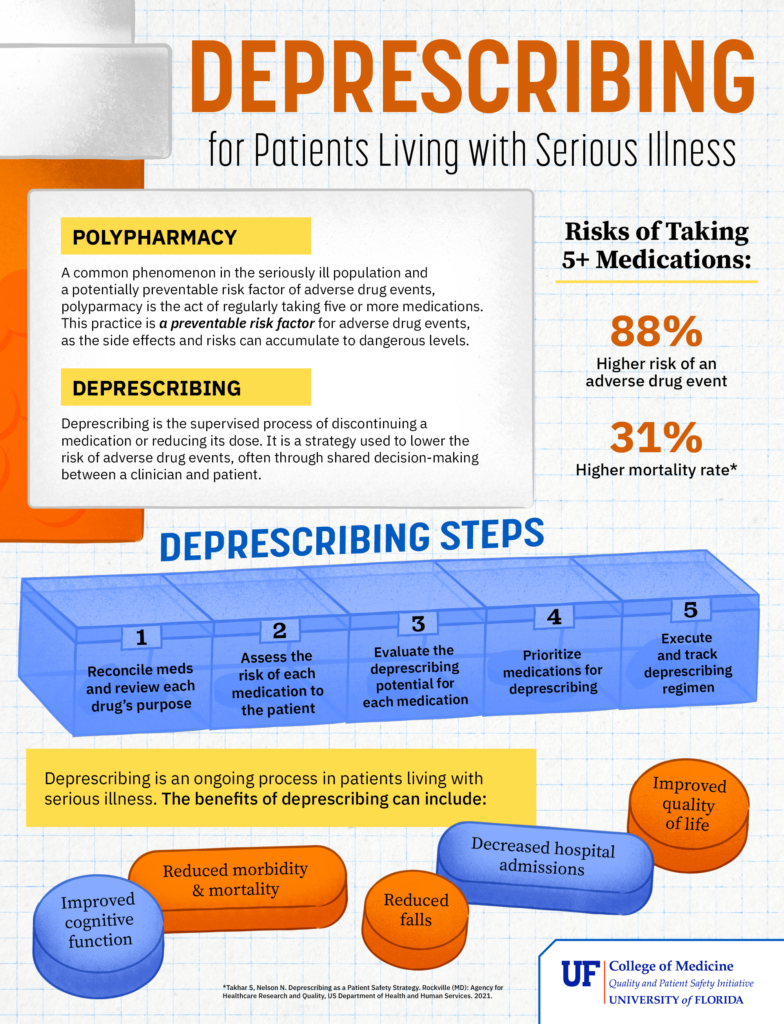
Download the Deprescribing Infographic
Learn more about deprescribing, including:
- How to evaluate and prioritize medications for deprescribing
- Steps for executing and tracking a deprescribing regimen