
 Patrick J Tighe, M.D., M.S.
  Nila Radhakrishnan, MD
 What is a Driver Diagram?
Starting a quality improvement project can feel like navigating a complex map without a compass. Your team has a clear goal, but how do you organize all your ideas and ensure every action you take is moving you in the right direction? A driver diagram is the tool that provides that clarity. It’s a simple, visual framework that helps your team map out its thinking, connect your goal to specific actions and build a shared strategy for success.
At its core, a driver diagram helps answer three fundamental questions:
- What are we trying to achieve?
- What key factors influence that goal?
- And what specific actions can we take to make an impact?
By linking your project’s Aim to its Primary Drivers (the main areas of focus) and Secondary Drivers (the actionable steps), you create a powerful roadmap. This structure not only clarifies the logic behind your improvement plan but also ensures everyone on the team understands how their work contributes to the bigger picture.
Resources
Explore resources you need to master this essential QI tool. Learn how to build a driver diagram that breaks down complex problems into manageable parts, focuses your team’s efforts, and drives measurable improvements in patient care.
Improvement Insights: Introduction to Driver Diagrams
This short video explains the concepts behind and the purpose of driver diagrams, including the aim, primary drivers and secondary drivers that are integral to pursuing quality improvement goals.
Transcript: Introduction to Driver Diagrams
How can a team efficiently organize its thinking about a quality improvement project? A Driver Diagram is a structured framework that organizes ideas and guides quality improvement efforts.
It helps teams map out their thinking and align efforts toward achieving quality and safety goals. A Driver Diagram answers three key questions. The answers to these questions form three key components of the quality improvement project.
First, what are you trying to achieve? This is your aim.
Next, what influences this goal? These are your primary drivers. These are the major factors or domains that directly impact the aim. They represent broad areas of focus and provide structure to the improvement effort.
Finally, what specific actions can you take? These are called your secondary drivers. These encompass the specific processes, behaviors, or actions that influence the primary drivers. They are actionable and detail the exact interventions needed.
Driver Diagrams foster shared understanding, identify areas of focus, and guide interventions systematically. They are commonly used in healthcare improvement initiatives to align stakeholders and track progress.
Driver Diagrams Downloadable Infographic
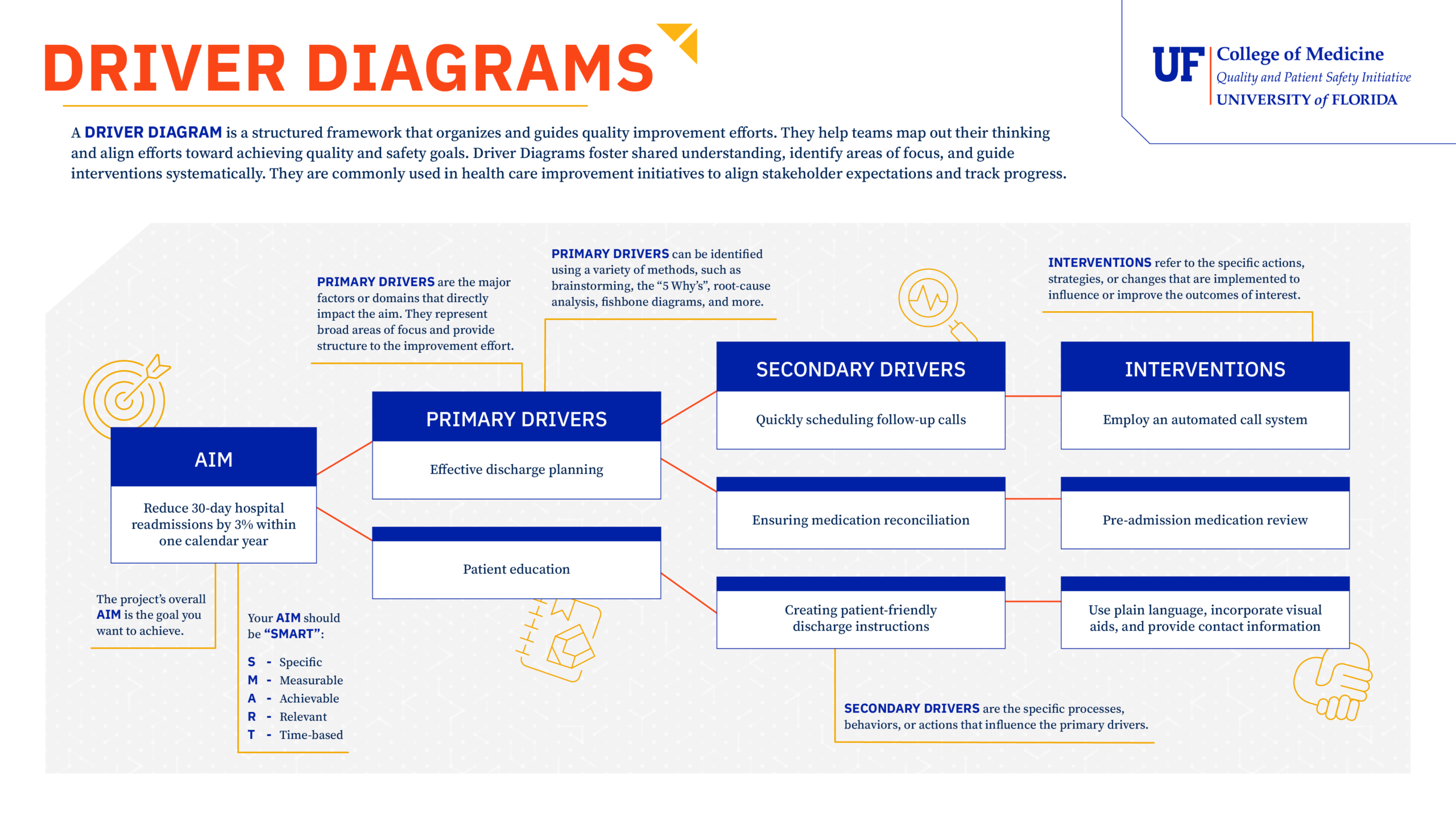
This infographic provides insight into the parts of a driver diagram, including the aim, the drivers and the interventions. It also reminds you that your aim statement should be in the form of a SMART goal.
Quality and Safety Unpacked: Driver Diagrams
Explore an example use of a driver diagram, including the formulation of an aim statement with SMART goals. Then learn how your team can identify primary and secondary drivers that impact your quality improvement goals.
Transcript: Driver Diagrams
A Driver Diagram is a visual framework that helps teams organize their improvement efforts. It connects a project’s overall aim, or the goal you want to achieve, with the primary drivers, which are the key factors or domains influencing that aim.
These primary drivers are then broken down further into secondary drivers, which represent specific, actionable steps that teams can take to make an impact.
Let’s apply this to a healthcare quality improvement project. Imagine our aim is to reduce 30-day hospital readmissions by 3% in the next year. Importantly, aim statements should be framed as SMART goals.
SMART goals are specific, measurable, achievable, relevant and timely. In this example, a Driver Diagram could help us identify the major factors that influence readmissions. These could include things like effective discharge planning, post-discharge follow-up, and patient education. These are our primary drivers.
Your team can use a variety of tools and frameworks to identify primary drivers. These might include the five why’s, a root cause analysis, a fishbone diagram, or other forms of brainstorming.
For each primary driver, we then list out specific secondary drivers, such as scheduling follow-up calls within 48 hours, ensuring medication reconciliation, or creating patient-friendly discharge instructions.
This framework not only helps us understand the relationships between different actions and outcomes, but also ensures that everyone on the team, from frontline staff to leadership, is aligned and working toward the same goal.
So whether you’re tackling infection prevention, improving patient satisfaction, or optimizing workflow efficiency, a Driver Diagram helps break the problem into manageable parts while keeping the big picture in sight.
Driver Diagrams Template
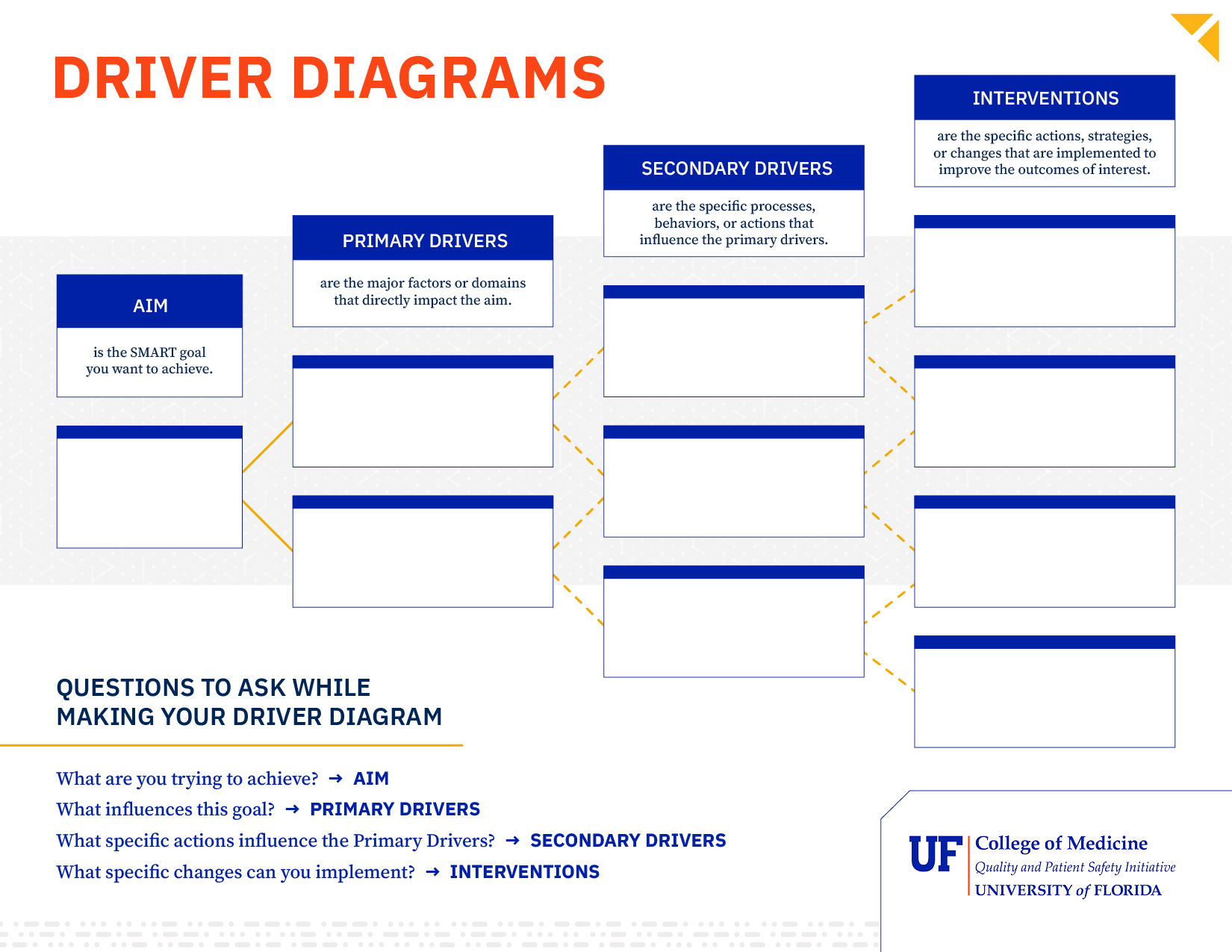
Use this template to guide your team in using a driver diagram to uncover important quality improvement opportunities, potential barriers, and appropriate interventions.