
Structured Storytelling for Quality Improvement
In healthcare, strategic plans and quality improvement initiatives can quickly become unwieldy, making it difficult to communicate goals and track real progress. The A3 approach—named for the single, standard-sized sheet of paper it is built on—offers an elegant solution. Originally pioneered by Toyota as a productivity and problem-solving secret, the A3 method condenses the entire lifecycle of a problem into one focused, easily digestible document. By limiting the space available, teams are forced to cut through the noise, find clarity, and focus strictly on what truly matters.
Using the A3 method is highly similar to conducting a clinical diagnosis. It requires teams to lay out the evidence and dig for root causes before ever jumping to solutions. This structured storytelling approach builds clear accountability and robust implementation plans, ultimately transforming static strategic goals into a dynamic process of continuous improvement. The resources below will introduce you to the A3 framework and provide the practical tools you need to start driving measurable change for your patients.
Resources
This collection of resources will guide you through the A3 problem-solving method, providing both the conceptual understanding and the practical templates you need to put this tool to work in your own clinical environment.
Understanding the A3 Framework
The A3 Approach: Quality Improvement on a Single Page
This introductory video explains how to turn a large strategic goal into real, measurable action using the power of structured storytelling. It walks through the essential components of an A3 document: setting the stage with the Background and Current Conditions, defining a measurable Goal, diagnosing root causes in the Analysis section, and finally developing targeted Recommendations, Implementation, and Follow-up plans. You will learn how the simple constraint of a single piece of paper forces clarity, fosters collaborative team thinking, and prevents healthcare plans from becoming static and unwieldy.
Transcript: The A3 Approach: Quality Improvement on a Single Page
How do you turn a big strategic goal into real action? In health care, our plans can become unwieldy, hard to communicate, and even harder to track. The A3 approach offers a solution.
Named for a single sheet of paper. The A3 method has been called a productivity secret for its creator, Toyota.
A3 is a powerful method for telling a complete story of the problem, from analysis to solution, all on one page. Think of it as structured storytelling for quality improvement.
You start by setting the stage.
The background explains why the problem matters and the current conditions show the data. What’s really happening now?
With the problem defined, you set a measurable goal.
But before jumping to solutions, you diagnose.
The analysis section is where you dig for root causes, just like you would with a patient. This evidence-based approach is the heart of the A3.
Only then do you develop recommendations or countermeasures that directly address those root causes.
Your implementation plan outlines the who, what, and when. Creating clear accountability.
Finally, the follow up section ensures you track your progress and learn from the results.
The A3 isn’t just about filling out boxes. It’s a visual tool for collaborative thinking. The one page constraint forces clarity, Helping your team focus on what truly matters. It transforms strategic planning from a static document into a dynamic process of continuous improvement, helping you drive real, measurable change for your patients.
Putting the A3 Method into Practice
Applying A3: An Example
This video demonstrates the A3 approach in action through an accessible, real-world example: a busy coffee shop struggling with long wait times. You will see how a team uses data and process mapping to establish their “Current Conditions” and applies the “5 Whys” technique in their analysis to uncover the true root causes of their bottlenecks. By diagnosing underlying system flaws rather than just treating the symptoms, the team is able to develop targeted countermeasures and a concrete implementation plan. While outside the clinical space, this practical walkthrough perfectly illustrates how you can leverage the exact same A3 steps to solve complex healthcare challenges, such as improving patient throughput, delivering high-value care, and implementing new safety protocols.
Transcript: Applying A3: An Example
Let’s see the A3 approach in action.
Imagine a popular coffee shop is struggling with long morning lines that wrap around the block. Customers are frustrated. Some leave without ordering, and staff feel overwhelmed during the rush.
The owner and her team decide to use the A3 method to find a real solution. They start by telling the story on a single page.
In the background section, they state why this matters. Customer satisfaction scores are dropping and they’re losing potential revenue when people walk away from long lines.
For current conditions, they don’t use guesswork. They use data. A simple time study shows the average wait time is 12 minutes, with lines peaking between 7:30 and 8:30 a.m.
A basic process map reveals multiple bottlenecks. A single espresso machine, cash only payments and customers deciding their order while at the counter.
With a clear picture of the problem, they set a measurable goal. Reduce average wait time to under five minutes during peak hours within two months.
Now, before jumping to solutions, they analyze. The team uses the five whys to dig for the root cause. Why the long wait? The line stops moving at the register. Why? Each transaction takes over two minutes. Why customers wait until reaching the register to read the menu and count out cash. Why? The menu boards are only visible from the front counter, and there are no card readers.
The root cause isn’t slow baristas. It’s a physical layout and payment policy that forces all decision making to happen at a single bottleneck.
This insight drives the recommendations. Instead of just telling staff to work faster, they propose countermeasures that address the root cause. Installing menu boards along the queue, adding card readers to speed up transactions, and implementing a mobile preorder system.
The implementation plan makes it real. It lists key actions, assigns an owner to each and sets a clear timeline.
Finally, the follow up section defines how they will track progress using the same wait time metrics from their current conditions section to see if their changes are working.
The A3 approach transformed a complex problem into a clear shared plan. The team didn’t just treat the symptoms, they diagnose the system and created a lasting solution.
While this example isn’t clinical, remember that the A3 approach can address challenges in health care, such as patient throughput, the application of high value care and the implementation of safety protocols.
Graphic Organizer: A3 Approach Worksheet
This downloadable graphic provides a ready-to-use template for your quality improvement projects. It includes designated sections to articulate your problem statement, detail the clinical or business background, and visually represent current conditions using charts, metrics, or process maps. It smoothly guides your team through establishing specific and measurable goals, conducting a root-cause analysis using tools like the 5 Whys or a simple fishbone diagram, and planning targeted countermeasures. Finally, it features an implementation plan to assign clear action items, owners, and due dates, along with a structured follow-up and monitoring section to track key metrics.
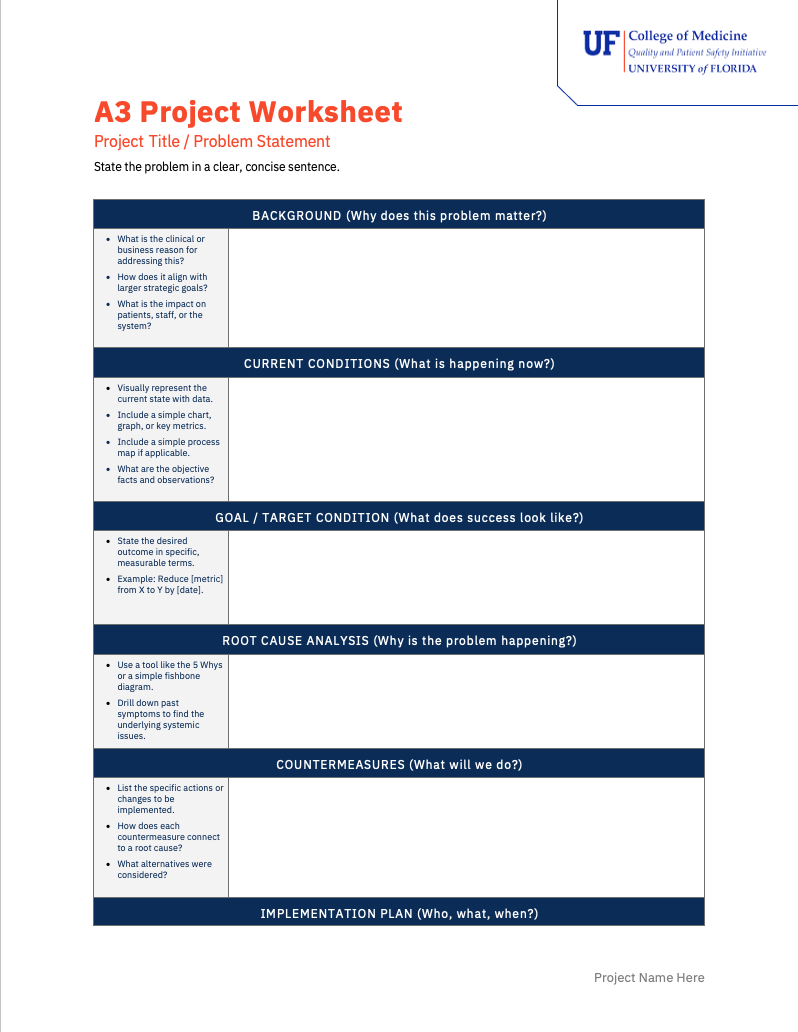
Download the A3 Approach Worksheet
The template contains various features to help you frame your QI project, including:
- Applying root-cause analysis tools like the 5 Whys or a simple fishbone diagram.
- Documenting an implementation plan for your project.
- Assigning action items, owners, and due dates.
- Tracking key metrics using the structures provided in the follow-up and monitoring section.