
 Michele Lossius, MD, FAAP
  Nila Radhakrishnan, MD
 Quality Improvement in Clinical Practice
Quality improvement is a systematic approach to examining how care is delivered and making evidence-informed changes to close the gap between what we know and what we do. It is not research in the traditional sense — it is the ongoing, practical work of ensuring that best practices reach patients consistently and equitably, across every setting and every provider.
For clinicians, QI often begins with a simple observation: that care varies, that outcomes differ, or that a process could work better. What distinguishes QI from informal problem-solving is its reliance on data, structured methodology, and collaboration. A well-chosen QI project — grounded in known evidence, focused on measurable outcomes, and built on strong partnerships — has the power to reshape care not just locally, but nationally.
Documenting QI Work for Academic Promotion
Your contributions to quality improvement and patient safety are vital, but demonstrating their value in a promotion packet can be a challenge. How do you ensure your leadership on a root-cause analysis, or the curriculum you developed on safety protocols, is fully recognized? The key is to systematically document and frame your achievements in language that academic promotion committees will understand and value.One solution is the Quality Portfolio, a framework developed by the Society of General Internal Medicine to help clinicians organize their work into six distinct categories — from project activities to leadership roles — creating a comprehensive picture of their impact. It begins with a personal faculty narrative, allowing you to tell your unique QI story and set the stage for the accomplishments that follow. The resources below trace that journey from first steps to formal recognition, with practical guidance for every stage.
Resources
The following resources trace the arc of a QI career — from the spark of a first project to the strategies that turn sustained work into academic advancement. Michele Lossius, M.D., F.A.A.P., Associate Chief of Staff and Associate Chair of Quality and Safety for Pediatrics at UF Health, shares her journey through five video conversations, accompanied by a practical tool for documenting your own work. These are followed by three videos that break down the Quality Portfolio framework, and a practical fillable form for documenting your own work.
Part 1: The QI Journey
Starting Your Journey: Quality Improvement and Why It Matters
In this opening video, Dr. Lossius recounts how her QI career began with a single question about national benchmarks and a common pediatric diagnosis — bronchiolitis. She describes how she navigated skepticism, worked within the boundaries of her immediate influence, and let data do the convincing. It’s an honest and energizing account of how one project, pursued with curiosity and persistence, can grow into something far larger than its starting point.
Transcript: Quality Improvement and Why It Matters
My name is Michele Lossius, a medical doctor, fellow of the American Academy of Pediatrics, and I serve as the Associate Chief of Staff and the Associate Chair of Quality and Safety for Pediatrics.
So I started with quality improvement work very early on in my career, really my first year out as a junior faculty member. I was at a national meeting, and they were discussing national benchmarks and how the federal government had given them to adult medicine, and pediatrics thought, “Well, maybe we should start doing some of the work ourselves and inform the federal government, if they’re going to benchmark us, what it should be on.”
Across the nation, they chose a very common diagnosis, bronchiolitis, that we knew is a common diagnosis, and we knew that there was literature about what you should and should not do from a medical care standpoint, but we also knew there was wide variation in care. So, it was the perfect project for QI.
That was at a time before EPIC, so I went to medical records and went through every chart, page by page, looking to see what we had done and what we had not done. I had no idea what I’d gotten myself into, and continued to partner with many in the institution around streamlining our care with bronchiolitis.
And I teasingly tell a story with our medical director of the ER at the time, because I went to her to say, “Can we do this project across the continuum of care from the ER through inpatient?” And she told me I was crazy. And so I did it just in the area where I could affect change, which was inpatient, on the general peds service.
And our impact was so great that I then took the data to her and said, “Okay, can we try it in the ER?” And she said yes. And so we had such significant change that we won an award through the American Academy of Pediatrics, and the rendition that came to subsequent studies or quality improvement projects later nationally asked us to help co-lead because of the dynamic between the ER and the hospitalist group was such a wonderful relationship that that was the next rendition of the project, was to bring on a co-partnership and look at the continuum of care.
So it’s around a diagnosis that we really do supportive care, so it’s actually de-implementation science, and that’s really where it started. And one thing literally led to another, both locally and nationally.
QI Work and Its Impact on Patients and Care
Dr. Lossius reflects on why QI work feels like a natural extension of patient care and what it has meant — concretely — for the patients she serves. She discusses how aligning care across the continuum reduced confusion, shortened hospital stays, and improved quality of life for families. This video makes a compelling case that QI is not an administrative exercise but a direct expression of clinical values.
Transcript: QI Work and Its Impact on Patients and Care
QI work has been important to me because I think in many ways, it just fits naturally with my personality and how I like to approach problems.
It’s often identifying a problem that we know the answers to, but we’re not doing it. So in many ways, the solution is already there. We just need to implement the change or de-implement what people might be doing.
And so it’s fun, it’s solving problems, and it’s also very collaborative work, and I enjoy teaming. And so I find it a natural part of patient care for me, but also the exciting and the fun part of working in an academic institution and working with other disciplines, because you often need nursing or respiratory therapy or pharmacy or all of them to participate in the QI intervention.
So for me, it really set the stage for the second half of my career. The first half of my career, much of it was built on advocacy in pediatrics, which interestingly enough, is a great foundation for QI because QI work is really about having stakeholders at the table from the beginning, getting everybody’s input, bringing everyone together, collaborative work, which there’s a lot of those aspects in advocacy.
So it was a natural transition, and then it was just really interesting work to me. It was solving problems and bringing solutions forward and getting to do that as a team.
And then I think for the patients, particularly around the diagnosis that really started QI work for me, it was clarification and transparency with the patients. It was helping the patients to experience seamless care as we worked through QI, so that what we were doing in outpatient looked similar to the emergency room, appropriately so, to the inpatient, to the ICU.
It wasn’t that you came into one part of the continuum of care, and we approached the same problem completely different than we did in another clinical space, that was just part of this, again, continuum of care.
So I think for the patients, it allowed them to truly understand what their care was going to look like, what it did look like, and was less confusing. It allowed us to provide education at the start of an admission.
And for many of them, in this particular diagnosis, doing less is truly doing more. And when we did less, we actually decreased length of stay, decreased readmissions, all things that impact them and their lifestyle, and for me, as a pediatrician, their parents, because if they’re not in the hospital and they’re a working parent, they can still go to work.
I think it impacted quality of life as much as it impacted their actual clinical care.
Turning QI Work into Promotion
Dr. Lossius walks through the stepwise way her local QI work translated into national visibility — from poster presentations to coaching other institutions to leading multi-site projects. She offers candid guidance on saying yes early, building a track record through smaller projects, and positioning yourself for larger leadership opportunities over time.
Transcript: Turning QI Work into Promotion
Much of what we do in academic medicine is academic in that there’s papers written, we’re changing the face of medicine, we’re sharing that broadly.
And then for those of us who spend much of our time as a clinician, for myself in the inpatient setting, how do you bring those two together and do great patient care, provide quality patient care, and then also leverage that into publications or sharing it nationally?
And I think for me, much of what I did was network. I would go to national meetings, and that would allow me opportunity to connect with others who had similar passions, but also share the work that we were doing.
So, poster presentations in particular are a lovely way both regionally and nationally to share the work that you’re doing. But at those meetings, also get other ideas, and it just kind of builds on itself to learn what others are doing and bring it back home and implement, but also share our ideas.
And so I think it just naturally, we did the work, and then something came available to share that work locally on a poster, and then that went national, and then there was a publication, and it just was this stepwise fashion of doing that.
So you asked specifically about an example, and for me, that was bronchiolitis. I engaged in a national QI project as the local site lead, and we had success. So the next rendition nationally, they asked if I would coach other institutions, and I said yes. And then the third rendition, they said, “Will you lead the project?” And I said, “Yes.”
And I think in academic medicine, we often wonder where the carrot is. Is there support for it, monetary or clinical time or that kind of thing? And often when you’re doing national work and QI work, it isn’t there initially, and you just have to kind of say, “Yes,” and do the work, and that’s easy if you’re passionate about it, which I was.
And so by doing that work in bronchiolitis, I then was asked to lead quality initiatives in pediatrics locally. And by doing that, I then was in a great place that some of the things we did in pediatrics were applicable to adult medicine, and they were spread across the institution.
So then when the opportunity to lead quality initiatives came up at a broader scope for UF Health, I had demonstrated success in other projects we had done to be able to say, “I can do this on a broader scale.”
So it was saying yes in the beginning to smaller projects that just kept building on themselves to a point that when the big asks were there, I had done the work to be able to say, “I know how to do this.”
Documenting and Showcasing Your QI Work
This video focuses on the practical work of making QI visible in a promotion packet. Dr. Lossius emphasizes setting measurable goals from the outset, tracking outcomes consistently, and connecting your work to institutional priorities. She also makes the case for combining quantitative data with narrative storytelling — including patient stories — to convey the full scope of your impact.
Transcript: Documenting and Showcasing Your QI Work
I think from the very beginning of a project, it is good to think about the outcomes for the project and then track those outcomes. In QI, the great thing is that you can often choose what your change will be. For example, is it 10%? Is it 25%? We often say that in QI, it is better to start a little smaller. Think about your project and then narrow it down a bit, because we can become so excited and thrilled about the project that we often want to boil the ocean. That is usually bigger than what we can realistically do at the time. The great thing about QI is that even if your change is only 10%, you can still demonstrate it, measure it, and show it. Those are all things you can include in a promotion packet or clinical portfolio.
In a promotion packet, you can describe each of the projects you have worked on, the roles you had in those projects, and the impact those projects had on patients or on the institution. Showing how your roles have progressed over time because of your success is one way to demonstrate impact. You can also show the actual changes in outcomes that occurred because of the projects that were completed. If possible, it is also helpful to look at cost. People, no matter what field they are in, understand money, and if you can convert what you have done in QI into dollars, that is often another way to demonstrate impact. You can also look at larger measures such as mortality, length of stay, or readmissions, which are concepts used frequently in QI. If you are able to show impact in those areas, it becomes very clear to those reviewing a promotion packet that there has been demonstrable change and impact.
Over time, the institution has become clearer about what its scorecard is each year. You can look back over several years and identify what you have worked on and how those projects connect to institutional priorities. Sometimes, though, in QI, your work is innovative and novel, and that is okay too. You may need to be creative in explaining how your work connects to broader goals, and you may need to draw that connection for others. Sometimes you may have found a novel way to impact patient care, and that is also important to highlight.
Another important way to demonstrate impact is by looking at learners. Since we are an academic institution, we should be teaching the next generation. If we are doing something that impacts readmissions, for example, what better thing to pass on to the next generation of care providers than how to do that better? In a promotion packet, you can demonstrate your impact on learners. This might include showing that five of your mentees went on to become quality officers at their next institution or took on leadership roles in quality as residents or faculty members. Showing how you have taught the next generation and how they have continued QI work is another way to demonstrate impact.
At least at the University of Florida, many of the questions within the portfolio templates are designed to help guide you toward successful answers. As you move along that journey, it is important to review those templates so that year by year, you are collecting the right information. Even if you are just creating a folder and placing information there, it will help when you begin working on your promotion packet. You are gathering all of that information over time because it can become a very large undertaking. It is important to know what the goal line is and what is being asked in a portfolio. If someone is working at an institution where that is not clear, they can look at examples from the internet to understand what kinds of information to capture.
It is also important to keep track of where you taught. Documenting lectures is important, as is knowing how those lectures impacted students. Feedback about your teaching is valuable, and both qualitative and quantitative feedback should be included. Curriculum that you have developed is also important to document. You should explain why the curriculum was created, how it is being implemented, and what impact it is having on students. For example, in pediatrics, the yearly in-training exam includes questions about quality and safety. We started to track that and obtained data from the program director each year to see how well we were doing in that space. It is not perfect, but as the person providing those lectures to the residents, I could at least say, “Look, 90% of our class gets 100% on these questions.” That is one way to show impact for residents.
For medical students and residents, you can also look at mentees. What have they gone on to do? What posters or presentations have they created? Again, any place where you present is important to document.
Advice for the Journey
In this closing conversation, Dr. Lossius shares what she wishes she had known at the start — from tracking your work systematically from day one, to finding partners who share your frustrations, to approaching new projects with strategic patience. It’s practical, reflective, and grounded in decades of experience navigating QI work within an academic institution.
Transcript: Advice for the Journey
I think there’s both the narrative and the quantitative. And so, determining how to craft the story that explains how you came to be a part of this QI project or develop it, the barriers, the joys, the celebrations that you encountered, and the impact, all of that is important.
And then also having quantitative data. And sometimes that’s in a table, sometimes it’s just we went from here to there. I think both of those are important for showing your QI journey and how it developed over time.
I really like storytelling, so I think the narrative’s important. I also think that if you have a particular patient story that you can share, often it has to be de-identified, but you can still share the impact of the change.
I will say, I think sometimes ignorance is bliss. Not knowing what I was getting myself into actually caused me to say yes to a lot of things.
I think some of the favorite advice that I got in the very beginning around a project was, find whoever else is as frustrated about this as you are, and partner with them.
And for us, around bronchiolitis, that was a respiratory therapist, because they were doing interventions that we were ordering that actually not evidence-based medicine. It’s not harmful, but it wasn’t helpful either.
And so we partnered with respiratory therapy, who was very eager to be at the table.
And then I would say, don’t be discouraged by the bumps. Expect them. They’re going to come, and just keep forging ahead.
I also think in truth, I wish I’d been a little bit more organized about the projects and the impact, and I jumped in and was all about the doing and excited about that part, and I didn’t think as much forward about how do I capture and track the work that I’m doing.
And I wish I had set up even just folders, or what am I measuring, and just tracked that a little bit better. There’s partners around that. Nursing does an amazing job of tracking what they do, when they do it, why they do it, what the impact and outcomes are, and I wish I had just asked a few more questions to those around me about how should I be tracking this, how should I capture this, so that the data is there for the work that I’m doing.
So I think my best advice would be take time each week to think about what you’re doing and what you’ve done, and write it down.
I think it was always very collaborative. I think it’s more strategic when it first came about, this option was in front of me, this project to fix something. I was eager about that, and I just jumped in.
I don’t think I had vision of where this was going at the time. And now, at the start of a project, my first question is, What’s the goal line? Where are we going? What do we want? Is that doable? Do we need to scale it back? Do we need to go bigger? Are the right people at the table?
And I think I also don’t feel as much pressure to get it off go immediately. I like to see things get done, but I recognize that if I take the time to set it up well, it will go faster, and we’ll get where we need to go.
So I think I’m a little bit more patient in the setup, and that may be the strategy that you’re asking about, being a little bit more strategic.
And also looking at the bigger picture, as you asked before, about what does the organization care about, what does the institution care about, what are national metrics that are starting to get captured? How does my passion align with those so that I can measure it appropriately and show that?
Part 2: The Quality Portfolio
The Quality Portfolio and Faculty Narrative
Learn how the Quality Portfolio helps clinicians showcase their QI and patient safety work for academic promotion. This video highlights the faculty narrative — a concise, reflective summary that frames your contributions and sets the stage for the detailed accomplishments that follow.
Transcript: The Quality Portfolio and Faculty Narrative
Contributing to quality improvement and patient safety is very important. Additionally, academic faculty also have to be mindful of how they can show progress for academic promotion.
And there is not always a clear way to demonstrate that in a promotion packet. This leads to an important question, “How can clinicians document their QI work, so it counts for promotion?”
The Academic Hospital Task Force of the Society of General Internal Medicine created the quality portfolio to address this question. The quality portfolio systematically documents activities and achievements in quality improvement and patient safety.
Its six categories help clinicians frame their work in a way that academic promotion committees will more easily recognize, understand, and thus value. The quality portfolio can be embedded in the clinical portfolio of an academic promotion packet.
The six categories of the quality portfolio are:
One, leadership and administrative activities.
Two, project activities.
Three, education and curricula.
Four, research and scholarship.
Five, honors, awards and recognition.
And six, training and certification.
In addition to these six categories, the task force suggests faculty members open their portfolio with a narrative, and conclude it with an appendix.
Let’s focus on the narrative for now. The knowledge base will have other resources that clarify the six categories.
The faculty narrative is a descriptive and reflective summary that relates a faculty member’s personal philosophy, achievements, challenges, future plans, and objectives related to quality improvement or patient safety.
The faculty member might describe participating in a leadership role, or iterative improvements in a process.
The task force recommends that the faculty narrative be one to two paragraphs long. The faculty narrative within a quality portfolio helps faculty members tell their QI story.
This critical piece sets the stage for the quality portfolio, and for recognizing faculty members important QI work.
Quality Portfolio Categories
See how to structure your Quality Portfolio across six categories — from leadership and projects to teaching, research, and recognition — so your QI and patient safety work is clearly documented and organized for promotion review.
Transcript: Quality Portfolio Categories
Once a faculty member has crafted their quality improvement narrative, what are their next steps with the quality portfolio? The quality portfolio contains six categories.
Accurately contextualizing previous QI work within these categories can support a strong argument for promotion. Luckily, the academic hospitalist task force provides clear guidelines for each category.
Faculty should document their QI and safety leadership roles, such as serving as a chief quality officer, leader of a root cause analysis team, or quality and safety curriculum developer. Each role should include the title, a summary of responsibilities, and a team description.
The task force recommends a length of two to three lines per role.
Faculty should detail their involvement in quality improvement or patient safety projects by including the project title, primary goals, time commitment, duration, role and contributions, outcomes and results, and any dissemination activities.
Emphasize measuring project effectiveness. Be sure to provide relevant results. The task force recommends you use formal methods for presenting results, such as statistical process control, time series, dashboards with benchmarks, or other relevant techniques. However, qualitative results are also acceptable.
Faculty should document their direct teaching activities and curriculum development efforts. For each teaching activity or curriculum development project, include:
One, the teaching activity.
Two, the time commitment.
Three, a description of the activity.
Four, the number and description of learners.
Five, the evaluation methods.
And six, any dissemination efforts.
While the quality portfolio expands the traditional criteria for promotion, the research and scholarly presentation of findings are still important. This category includes peer-reviewed publications and presentations, grants or contracts, and enduring educational materials.
The final two categories are very straightforward. Faculty should include any honors, awards, and recognition, as well as training and certification related to QI and safety.
Aligning QI Work and Faculty Promotion
This video offers practical strategies for aligning your quality improvement and patient safety efforts with academic promotion criteria, showing you how to frame your contributions across clinical, educational, and scholarly domains.
Transcript: Aligning QI Work and Faculty Promotion
Your contributions to quality improvement and safety are essential to your patients and your larger health care organization. Aligning our QI and safety efforts will pay off when you need to demonstrate your achievements, for example, when under consideration for academic promotion.
Here are a few quick ideas to get you started on the path.
Clinical contribution. Quality improvement and patient safety efforts ultimately improve clinical outcomes. Collaboration across disciplines and departments is essential to implement quality initiatives and demonstrate impact for academic promotion.
Connecting across departments in your institution also helps to develop partnerships, which can be helpful for internal letters for academic promotion.
Educational contribution. Teaching residents and students about quality improvement and patient safety is essential as we train the next generation of caregivers. Aligning your teaching with quality improvement helps develop and demonstrate expertise in this area, and thus can support your academic promotion.
Scholarly activity. Consider studying and publishing the quality improvement work and projects you are doing. You can present local, regional, and national posters or abstracts. Ideally, you and your team can publish peer-reviewed papers on your quality improvement work.
Service. Consider how you can serve your professional academic society in a quality and safety committee. Service helps to build a regional and national presence. You can form partnerships to present workshops or talks through networking in professional societies.
You will also need external recommendation letters for academic promotion, so networking will help find individuals who participate in quality improvement work and are best suited to understand the value of your QI work.
Finally, consider creating a portfolio of your quality work. The Society of General Internal Medicine Academic Hospitalist Task Force has written a clear overview of what that portfolio should contain. The crux of the portfolio is creating a compelling narrative.
This narrative should clearly explain your accomplishments in general terms, since reviewers may not be from your field. The key point of the portfolio is to document and contextualize your achievements. You can find more details on the portfolio in the Knowledgebase.
In short, you can support your academic promotion portfolio by aligning your quality improvement and patient safety efforts into the categories of clinical, educational, scholarly, and service.
Part 3: Your Next Step
Quality Portfolio (Fillable Form)
This fillable form gives you a structured framework for documenting your QI and patient safety work across six categories: Leadership and Administrative Activities, Project Activities, Education and Curricular Activities, Research and Scholarship, Honors and Awards, and Training and Certification. Use it alongside the videos above to begin building or refining your own promotion documentation. The form is adapted from the Academic Hospitalist Taskforce’s Quality Portfolio framework (Taylor et al., Journal of General Internal Medicine, 2013).
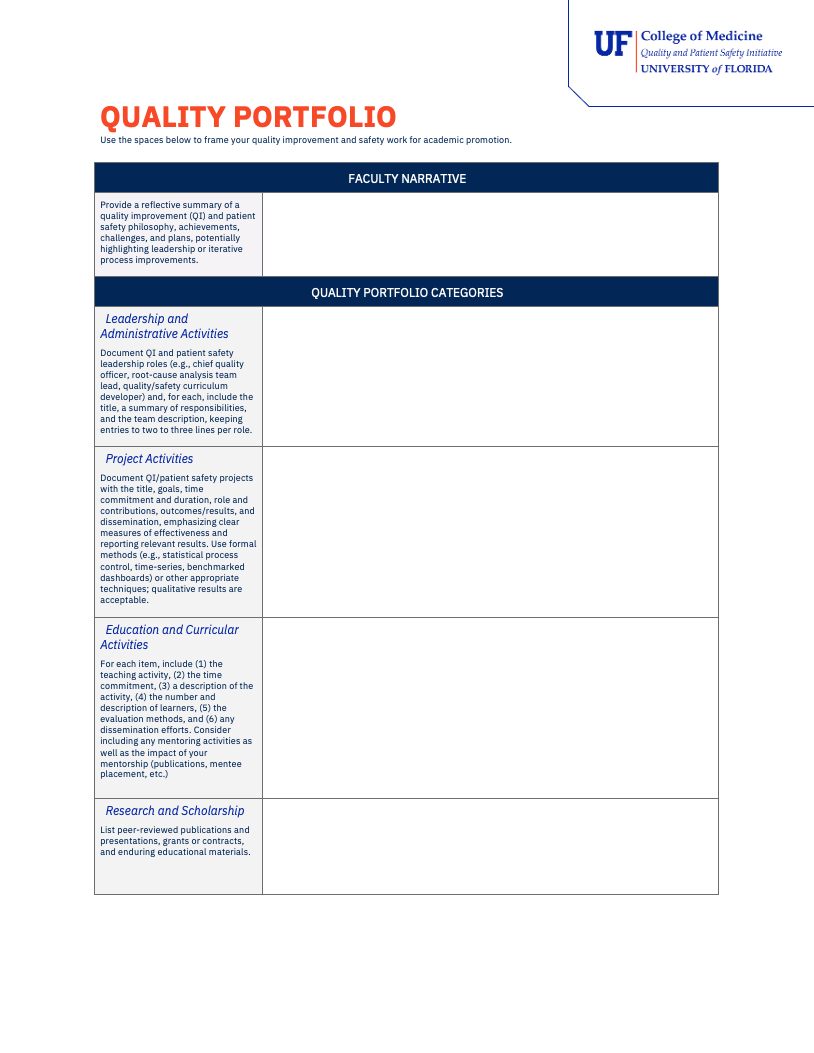
Download the Quality Portfolio Fillable Form
Use this Microsoft Word document to organize and record your QI work for use in your promotion packet.
Key components of the form:
- A reflective summary of your QI and patient safety philosophy, achievements, and plans.
- Documentation of leadership roles, such as chief quality officer or team lead.
- Details on specific QI projects, including goals, your role, outcomes, and dissemination.
- A record of teaching and mentoring activities related to quality and safety.
- A list of peer-reviewed publications, presentations, and grants.
- Honors or awards received for your QI and safety work.
- Documentation of relevant training and certifications.