
 Brandon Allen, MD
 Why Standardization Matters in Healthcare
Healthcare is complex, and clinical teams operate under significant cognitive load — especially during busy or high-acuity shifts. Standard workflows act as guardrails, ensuring that important steps are not missed and that patients receive consistent, reliable care regardless of who is on shift or how demanding the environment is. When routine processes depend on individual memory or preference, they are vulnerable to variation that has nothing to do with the patient’s needs. Standardization eliminates that unnecessary variation and creates the stable baseline from which improvement can actually be measured.
One of the most common reasons QI initiatives fade over time is that the improvement never gets embedded into the system. Sustaining a change means building it directly into how work is normally done — through care pathways, order sets, checklists, or team protocols — rather than relying on individual effort to keep it alive. Standardization is what converts a successful PDSA cycle into a durable result. The resources below introduce the core rationale for standardization, address the most common misconception clinicians encounter, and illustrate the difference between standardization that supports care and rigidity that undermines it.
A Note on Clinical Judgment
The most common source of resistance to standardization is the concern that it eliminates clinical judgment. It doesn’t — and this distinction matters enough to address directly. Good standardization handles the predictable and routine so that clinicians can direct their expertise where it is most needed. A chest pain pathway, for example, ensures that every patient receives prompt, evidence-based evaluation and risk stratification — reducing delays and preventing harmful variation. But when a patient’s presentation falls outside the pathway, the clinician’s judgment takes over, and the pathway is designed to accommodate exactly that. Standardization removes unnecessary variation. It preserves the judgment required for individualized care.
The goal is not rigid medicine. The goal is reliable medicine with thoughtful flexibility.
Resources
The following resources make the case for standardization — and explore where structure helps versus where it hinders.
Understanding Standardization
Standard Workflows & Protocols — Building Reliability Without Rigidity
Brandon Allen, M.D., Associate Professor and Medical Director for the Department of Emergency Medicine at UF’s College of Medicine, introduces the core rationale for standardization in clinical care — including how standard workflows reduce harmful variation, sustain QI gains, and support clinical judgment rather than replace it.
Transcript: Standard Workflows & Protocols — Building Reliability Without Rigidity
Hello, I’m Brandon Allen. I serve as a professor of emergency medicine and medical director for our department, as well as the associate chief medical officer for UF Health in the Gainesville market.
As we know, in health care, variation can be both helpful and harmful. Helpful variation comes from thoughtful clinical judgment tailored to an individual patient. Harmful variation happens when routine processes depend too much on memory, habit, or individual preference.
Healthcare is definitely complex and humans are excellent problem solvers, but we are not perfect at repetitive tasks. Standardization helps create consistency in routine care so teams can focus their attention where it matters most. Standard workflows and pathways help reduce unnecessary variation so patients receive safer, more reliable care every time.
One of the biggest goals in quality and patient safety is creating reliability. Standardization gives teams a shared approach to common processes. So care becomes more predictable, measurable and hopefully safer. In many ways, clinical care pathways and workflows act like guardrails. Like when I’m bowling, they help ensure that important steps are not missed during busy or high volume situations.
Importantly, you cannot accurately measure whether a change is an improvement if everyone on the team has performed the test differently to begin with. Standardization creates that reliable baseline where measurement can be done well.
Many quality improvement initiatives initially succeed, but gradually fade over time. One of the main reasons for that is that the improvement never becomes part of the standard workflow. Sustainable improvement requires building the new process directly into how work is normally done through pathways, checklists, order sets, documentation tools, or team workflows. For example, when your team reaches the final Act phase of a PDSA cycle and decides to adopt a successful change, standardizing that workflow is exactly how you lock that win into place.
A simple framework that we can all talk about has three major things. We want to standardize and create a reliable baseline process. Number two, measure. Track variation outcomes and opportunities. And third, we’re always trying to get better. So let’s try to improve and refine workflows using frontline feedback and data to get better. When improvement becomes part of the system, instead of relying only on individual effort, results are much more durable and sustainable.
A common misconception is that standardization eliminates clinical judgment. In reality, good standardization supports clinical judgment. An example from automobiles. Much like how standardized car controls free a driver to focus entirely on navigating traffic, standard clinical workflows offload the cognitive burden of routine tasks. This preserves clinical team members’ critical thinking and energy for the complex situations that truly require individualized decision making. The goal is not rigid medicine. The goal is reliable medicine with thoughtful flexibility based on the patient in front of you.
For example, in my work, standardized chest pain pathways help ensure that every patient receives evidence-based evaluation and risk stratification. Those things reduce delays, improve consistency, and decrease preventable variation while still allowing clinical team members to apply judgment when patients do not fit the pathway clearly. In observation medicine, standardized workflows can improve throughput, reduce unnecessary admissions and readmissions, and create a more predictable patient experience. At the same time, interdisciplinary pathways are always paired with reassessment and clinical oversight.
Even simple tools like checklists have consistently been shown in the literature to reduce preventable harm in health care, because they help teams perform reliably during busy or cognitively demanding situations like surgeries.
Ultimately, standardization is not about replacing clinical team members. It is about supporting and augmenting them. High-performing systems create reliable processes for routine care, while still empowering teams to use critical thinking, communication and clinical judgment when patients need individualized care. When done well, standard workflows and care pathways become a foundation for safer care, better teamwork, and sustainable quality improvement.
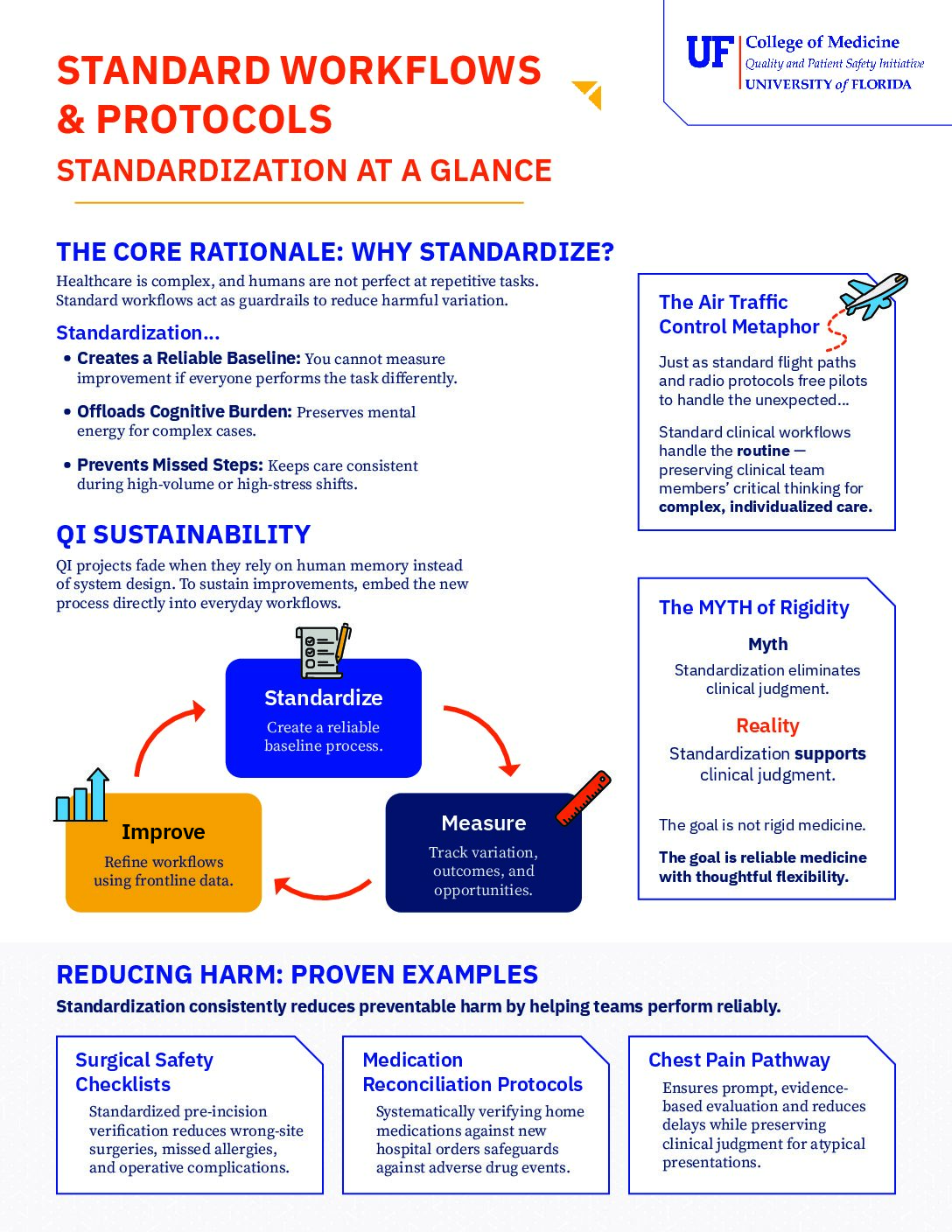
Infographic: Standardization at a Glance
A visual summary of the core rationale for standardization in healthcare, including the evidence behind it and the most common misconception clinicians encounter.
Download Standardization at a Glance
Key takeaways:
- Standard workflows as guardrails against harmful variation
- Standardization as the baseline for meaningful QI measurement
- Embedding changes into workflows to sustain QI gains
- Why standardization supports — not eliminates — clinical judgment
Recognizing the Difference
Comparison Table: Appropriate Standardization vs. Counterproductive Rigidity
This side-by-side table illustrates the distinction between standardization that supports care and rigidity that undermines it, using four concrete clinical examples.
| ✓ When It Works | ✗ When It Goes Wrong | |
|---|---|---|
| Clinical Pathway | A chest pain pathway ensures every patient receives evidence-based risk stratification and timely evaluation — while the clinician applies judgment when the patient doesn’t fit the pathway. |
A chest pain pathway is applied identically to a patient whose presentation clearly falls outside its scope, delaying recognition of an atypical condition. |
| Checklist | A surgical safety checklist prompts the team to confirm site, allergies, and equipment before every procedure — freeing mental energy for the operation itself. |
A checklist becomes a rote “check-the-box” exercise completed without team engagement, creating false confidence that nothing was missed. |
| Care Bundle | A sepsis bundle standardizes the timing of blood cultures, fluids, and antibiotics so that time-sensitive steps aren’t missed during a busy shift. |
The sepsis bundle is triggered and followed in full even when the clinical picture has evolved and no longer supports the diagnosis, overriding the clinician’s updated assessment. |
| Handoff Tool | A standardized handoff tool ensures every receiver gets the same critical information at every care transition, regardless of who is handing off. |
A handoff tool is used so rigidly that clinicians feel unable to add context or flag an evolving concern outside the standard fields. |