
 Leah Blackwell, MSN, MBA, RN
Understanding Culture of Safety
Culture of Safety represents the shared values, attitudes, and behaviors that prioritize patient safety above all else within healthcare organizations. Unlike temporary programs or campaigns, safety culture is an enduring foundation that influences how clinical teams communicate, respond to errors, and make decisions in their daily practice.
The strength of an organization’s safety culture directly impacts the effectiveness of every other safety initiative. When psychological safety exists, team members feel empowered to report concerns, participate in improvement projects, and challenge processes that may compromise patient care. This cultural foundation enables continuous learning and improvement while maintaining the accountability necessary for high-quality patient outcomes.
Resources
These learning assets will help you understand and implement Culture of Safety principles in your clinical practice, moving from theoretical concepts to practical application and reference tools.
Why Safety Culture Matters
UF Health Shands Chief Nursing Officer Leah Blackwell, MSN, MBA, RN, explains how safety culture serves as the essential foundation for all patient safety initiatives. Learn about the culture spectrum and discover how psychological safety enables both effective error reporting and successful improvement initiatives.
Transcript: Why Safety Culture Matters
Every protocol, every improvement initiative, every training you complete only works if it’s built on the right foundation. That foundation is safety culture. But I want to be clear about what safety culture actually is, because it’s not a program or a campaign with a start and end date. It’s a shared set of values and behaviors — the way clinical team members should treat each other, the way they respond to mistakes — and the way they prioritize the patient in every decision, every day.
It helps to understand what safety culture looks like across the spectrum. In a punitive culture, mistakes are met with blame and punishment, so people hide them. In a blame-free culture no one is ever held accountable and that creates its own risk. Just culture is the middle path: it holds systems accountable while still recognizing individual responsibility. It creates the psychological safety that allows people to report errors and near-misses honestly, without fear — because they know they’ll be treated fairly.
That psychological safety isn’t just what allows a team member to report a medication error. It’s what allows someone to say, “I don’t think this process is working” during an improvement project, or to flag a concern during the PDSA cycle — before it becomes a patient safety event.
Safety culture is the foundation for improvement work, not just incident response. When safety culture is strong, everything else works better. Communication improves. Teams perform better. Patients are safer. When it’s weak, no initiative, no matter how well designed, can fully compensate.
Learning from Mistakes: Shifting from Blame to Improvement
Discover how Just Culture principles work in practice by learning to distinguish between different types of errors and respond appropriately to each. This video covers what to report, why reporting matters, and how shifting focus from individual blame to systemic learning drives better outcomes.
Transcript: Learning from Mistakes: Shifting from Blame to Improvement
When something goes wrong, the instinct in many organizations is to find who is responsible and them accountable. I understand that instinct, but in health care, a blame culture doesn’t make patients safer. It makes us less safe. Here’s why. When people fear punishment for reporting errors, they stop reporting. And when reporting stops, we lose the information we need to prevent the next event.
Just Culture offers a different path. It distinguishes between human error, at-risk behavior, and reckless conduct, and responds to each appropriately. Human error calls for support and learning. At-risk behavior calls for coaching and course correction. Reckless conduct calls for accountability. It doesn’t mean there are no consequences. It means consequences are fair and learning is always the priority.
And what we’re asking you to report goes beyond obvious errors. Near-misses — moments when something almost went wrong but didn’t — are among the most valuable signals we have. They reveal vulnerabilities in the system before harm occurs. Latent errors are the hidden weaknesses already present in our processes that haven’t caused harm yet, but will if we don’t find them first. Reporting these is not an admission of failure. It is a proactive act of care.
When we shift from asking “who did this?” to “what allowed this to happen?”, we start finding the systemic causes, the staffing pressures, the unclear processes, the communication gaps that no individual accountability measure could ever fix. That same shift in thinking is what drives effective quality improvement. The honest debrief after a PDSA cycle, the willingness to say a change idea isn’t working. These require the same courage and the same culture.
Reporting an error or near-miss triggers institutional learning, including formal processes like root cause analysis, and is an expected non punitive professional behavior. If you’re ever unsure about next steps after an event, your risk management team is there to guide you.
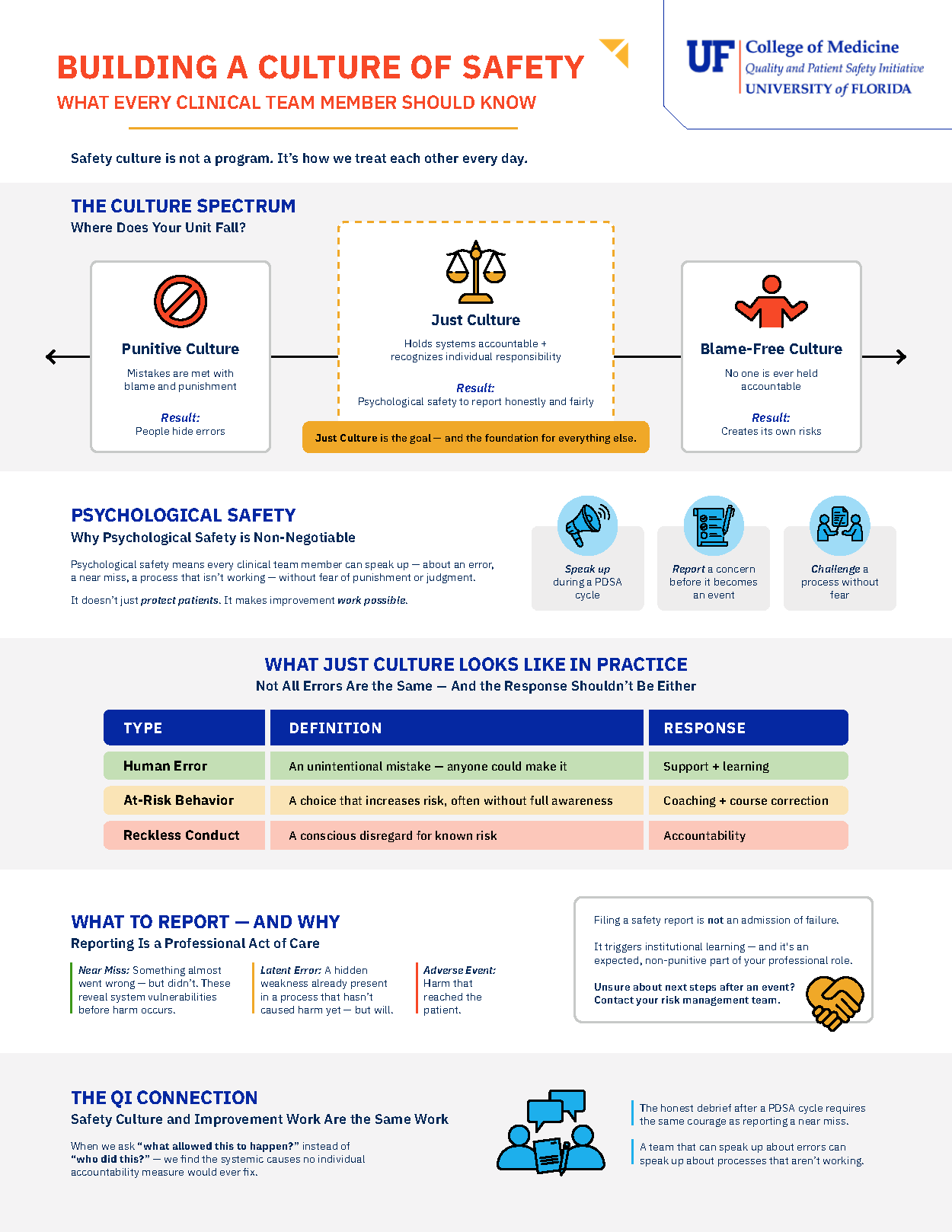
Building a Culture of Safety: What Every Clinical Team Member Should Know (Infographic)
This comprehensive infographic serves as a visual reference for key Culture of Safety concepts. Use this resource to understand what and why to report, recognize the connection between safety culture and quality improvement, and access practical guidance for implementing these principles in daily practice.
Download the Building a Culture of Safety Infographic
Some features of the reference guide:
- Maps the culture continuum from punitive to just to blame-free approaches
- Defines psychological safety and its role in improvement work
- Provides clear guidance on how to respond appropriately to different types of errors