
 Peter Iafrate, PharmD
  Lynne Meyer, PhD, MPH
 QI and Research: Similar Methods, Different Goals
Quality improvement and clinical research are both systematic, data-driven approaches to advancing healthcare — but they serve fundamentally different purposes. Research seeks to generate new, generalizable knowledge that extends beyond a single institution, often testing a hypothesis across larger populations using fixed protocols. QI, by contrast, applies existing knowledge to improve a specific local process, program, or system, using short iterative cycles that can be adjusted in near real-time to meet a defined quality goal.
That distinction carries real consequences. Research may place participants at risk in service of knowledge that benefits society broadly, while QI is designed to benefit the patients within a specific system without increasing risk beyond standard care. Knowing which framework applies to your project shapes everything from team structure and study design to whether IRB oversight is required.
QI and Research: Key Differences in Stakeholder Involvement and Data
Stakeholder Involvement
Quality improvement is a collaborative process that actively engages the people closest to the work — frontline staff, clinicians, and operational leaders — in designing and testing changes to local processes. Research teams tend to be more specialized, led by investigators with subject-matter expertise. While research participants contribute data, they are generally not involved in shaping study design once a protocol is established.
Data
QI projects typically rely on smaller, practical data samples that allow teams to monitor performance in real time and assess whether changes are leading to improvement. The emphasis is on learning and adapting quickly, rather than achieving statistical proof. Research studies, by contrast, require larger and more rigorously designed data sets to produce results that are statistically valid and generalizable to broader populations.
Common Challenges in QI Data Requests
Data is one of the most frequent pain points in quality improvement work. Several patterns tend to complicate the process:
Requests without a defined problem
One-time reports drawing on extensive retrospective data are often labeled as “quality” work without a clear problem statement or plan for ongoing monitoring.
Data requested after project completion
When data collection follows rather than precedes a project, it can be difficult to distinguish quality improvement from retrospective research.
Individual rather than team-based efforts
Quality improvement requires a collaborative, multidisciplinary approach. Without a team structure, initiatives are less likely to result in sustainable, practice-level change.
Resources
The resources below build a practical understanding of QI vs. research, starting with the conceptual foundation and moving through the key elements of designing and executing effective QI work.
Understanding the Core Distinction
Differentiating QI from Research
In this video, Lynne Meyer, PhD, MPH, Director of Graduate Medical Education at UF’s College of Medicine, walks through the key differences between clinical research and quality improvement. She covers purpose, design, who benefits, what risks are involved, and how each initiative concludes — giving clinicians a clear conceptual framework for categorizing their own work.
Transcript: Differentiating QI from Research
Hello, I’m Lynn Myer, PhD, MPH. I’m the director of graduate medical education at the University of Florida’s College of Medicine.
In health care, we constantly strive to get better. Two key approaches that help us do this are clinical research and quality improvement, or QI. While both involve a systematic approach to data, it’s crucial to understand their fundamental differences as they have distinct goals, methods, and implications.
Let’s start with their purpose. The primary goal of research is to generate new, generalizable knowledge that often extends beyond the institution. Research begins by seeking to answer a question, test the hypothesis, or establish clinical practice standards. A hypothesis is a testable, educated prediction about the relationship between variables that tests “what.” Essentially, it ventures into the unknown to create a new map for everyone.
QI on the other hand is not about creating a new map but about improving the journey on the one we already have. QI’s starting point is a desire to improve local institutional performance using existing knowledge to manage the project’s milestones. The purpose is to assess and promptly improve a specific local process, system, program, or performance, measuring it against standards that are already established and accepted.
QI projects often start small, use manageable data to track progress, and involve the frontline teams responsible for the process being improved. Research projects, on the other hand, typically require larger study populations, fixed protocols, and formal study teams to ensure scientifically rigorous results. These different purposes dictate their design.
A research study follows a rigid fixed protocol. The interventions don’t change as data is collected, because the goal is to test the hypothesis consistently. Research projects typically use a long-term, one pass analytical method that covers many months or years. In contrast, a QI project is adaptive. It’s short term, iterative cycles of interventions are often adjusted in real or close to real time based on incoming data to help ensure the quality goal is met.
QI projects are often completed in weeks or months for rapid, specific improvement. This also affects who benefits and what risks are involved. Research is designed to benefit society through generalizable knowledge, but it may not directly benefit the individual participants and can sometimes place them at risk.
QI is designed specifically to benefit the patients within that system or program, and by design, it does not increase patient risk beyond standard care, with the main exception being potential privacy concerns. Finally, their endpoints differ. A research project concludes when the research question is answered, often by statistically proving or disproving a hypothesis. The QI initiative concludes when the process is successfully improved and maintained, which is measured by comparing the system’s new performance against an established quality standard.
In summary, think of it this way: research seeks to provide new knowledge or concepts that add to generalizable knowledge. QI seeks to improve performance, a program, a process, or a system based on established standards for the benefit of a specific site or group. Understanding this distinction is vital for ensuring ethical oversight and effective progress in health care.
Determining IRB Oversight
Does Your Project Require IRB Oversight? Self-Certification Questions
Dr. Meyer presents the six self-certification questions developed by the UF Health Quality Improvement Project Registry to help clinical teams determine whether their project is QI or research. Each question targets a specific indicator — such as intent to generate generalizable knowledge, involvement of experimental interventions, or multi-site scope — and walks through what each answer signals about IRB review requirements. Teams are reminded that while these questions are a strong guide, any uncertainty should be referred directly to the Institutional Review Board.
Transcript: Does Your Project Require IRB Oversight? Self-Certification Questions
The UF Health quality improvement project registry has developed a series of questions to help clinical teams distinguish research from QI.
These questions consider the following aspects of a proposed project. Has this project received funding to be conducted as human subjects research? If yes, IRB review may be required. Next, is the project intended to contribute to generalizable knowledge? If yes, the project’s intent indicates research design, and IRB review is likely required.
Will the project involve testing an experimental drug, device, or biologic? If yes, the project falls under FDA regulations and likely requires IRB review. Is the project meant to improve or evaluate the practice or process within a particular institution or a specific program? If no, the project’s intent is research, and IRB review may be required.
If yes, quality improvement is likely, and IRB review may not be necessary. Will the project occur regardless of whether individuals conducting it may benefit professionally? If no, the project suggests a research focus. If yes, the project’s continuation is independent of professional gain.
Will the project occur across multiple sites? If yes, this signifies potential generalizability and may necessitate IRB review. Notice that the answers to these questions can help a team recognize whether a project is research, but they are not absolutely definitive. If there is any question, be sure to reach out to the appropriate team at the Institutional Review Board.
QI in Institutional Context
What Is Patient Safety and Quality Week — and Why It Matters
This video offers a firsthand look at how UF Health celebrates and elevates QI work through its annual Patient Safety and Quality Week. A reviewer of project proposals describes the event as an institution-wide opportunity to showcase improvement efforts, earn CME credit, discover cross-departmental collaboration, and draw inspiration from the breadth of frontline-driven projects completed each year. It provides clinicians with a motivating glimpse of where their own QI work could lead.
Transcript: What Is Patient Safety and Quality Week — and Why It Matters
Hi, my name is Lynn Meyer. I am in the College of Medicine in the Office of Graduate Medical Education. I’m the director of graduate medical education and for accreditation for all of our residency and fellowship training programs that we have.
Patient Safety and Quality Week is a reminder for us of the importance of us working together to improve the quality of patient care and patient safety. And it’s also a way for us as an institution to showcase our efforts that we’ve been able to achieve over the past year. It’s a way to have poster presentations and show the different projects that we’ve worked on. It’s having some of the best projects, having speaker presentations and people being able to hear about those.
Having guest speakers come in and having opportunities to learn about different topics that maybe you haven’t learned about before and attending those subjects. And it goes on for an entire week and it’s doing fun activities. It’s a really fun way to learn.
It’s a good way to get some CME or continuing education activity. And it’s a great way to learn about what’s going on not only in your area, but in other areas at the hospital that you haven’t heard before. And maybe even give you ideas of people you may want to work with in the future for next year, or ideas for topics that you might want to get involved with for next year.
As to reviewing proposals for Patient Safety and Quality Week, I have to say that every year we usually have more proposals than the year before. It always amazes me that we have the depth and breadth of the projects that we’ve had. Everything from working with new mothers, literacy for patients, getting patients the social care that they need, working with prostheses, working with preventing infections, repeat visits to the emergency department or being readmitted to the hospital.
Working on goals that the hospital has and that the teams that are working on this are the frontline workers, so it’s really amazing seeing all the different varied projects throughout the different organizations.
Designing a Strong QI Project
This group of videos features Lynne Meyer, PhD, MPH, Director of Graduate Medical Education at UF’s College of Medicine, drawing on her extensive experience reviewing QI proposals to share what separates projects that succeed from those that struggle. Together, they offer a practical guide to the core elements of well-designed QI work.
Green Flags: What Strong QI Proposals Look Like
Dr. Meyer shares the first things she looks for when reviewing a QI proposal: a well-written SMART goal and an interprofessional team. She explains how a clearly defined, specific, measurable, achievable, realistic, and time-bound goal signals that a team has genuinely thought through their project — and why representation from across disciplines and frontline roles is essential to a project’s credibility and success.
Transcript: Green Flags: What Strong QI Proposals Look Like
When I look at projects, when I’m reviewing them, I have to admit the first thing I look for is what is their SMART goal? Because if they have a well-written SMART goal, that tells me they really have well thought out what they’re doing for the QI project. It’s specific, it’s measurable, it’s achievable, it’s realistic, and it’s time-measurable.
All of those things have been considered. They have data that they’re going to use, it’s measurable outcomes, they’re looking at the whole thing. If they don’t have that, that tells me it’s not as well defined, and it’s probably not as likely to be achievable.
The other thing I look at is who are the team members. To me, a team needs to be interprofessional and interdisciplinary. So in other words, it should not just be all nurses, it should not be all just physicians.
It should be a combination of different types of physicians, different types of nurses who are on the frontlines of this problem that you’re trying to solve. Who’s all involved with this? It could be anybody from pharmacy, clinical engineering, nursing, physician care.
So all of those different people who are involved with this, you know, radiation technology. They should all be involved in the project, not just one particular type of health care provider.
From Too Broad to Just Right: The Power of a Focused QI Project
Scope creep is one of the most common pitfalls in QI work. Dr. Meyer explains why narrowing a project’s focus is critical to knowing where you’re headed — and illustrates the point with a compelling real-world example of a cardiology team that traced missed appointments to a bus stop a mile from the clinic, then worked with the transit authority to solve the problem directly.
Transcript: From Too Broad to Just Right: The Power of a Focused QI Project
One of the issues with having a project that is so broad is you don’t know where you’re going. It’s almost like throwing darts at a map and just saying, where am I going to go? If you can narrow your focus, which is so important for any project, you have specific goals in mind. If you don’t have that in mind, you don’t know where you’re headed.
If you can’t get that focus set at the beginning, you’re not going to be able to go anywhere. Actually, I have a really good example. We had patients who were not making it to their appointments, and people were thinking, oh, what’s the reason? Well, they didn’t remember. They just didn’t care to come.
They did some investigating. So, what they found out was a lot of these patients didn’t have the resources a lot of us have. And so a lot of them were forced to take public transportation to get to their doctor appointments. They were having to take the bus. The nearest bus stop was a mile away from the physician’s office, and they were going to the cardiac cardiology appointment. And so they were having to walk a mile from the bus stop to the cardiologist’s appointment, which was not good.
So they actually met with the bus company, and they arranged, made arrangements, and the bus stop now is. They have a bus stop. It was much better and solved the problem. Patients are getting to their appointments and it’s because of that focus, they did some investigating and they saw what the actual problem was.
They got down and were able to meet with people and fix that problem and solve it.
Good Data, Bad Data: Building a QI Measurement Plan That Actually Works
A strong QI project requires not just measurable outcomes, but the right outcomes. Dr. Meyer walks through the difference between data you can collect and data that actually answers your improvement question — using the example of measuring clinician knowledge before and after training, and why that alone cannot tell you whether patient care has improved.
Transcript: Good Data, Bad Data: Building a QI Measurement Plan That Actually Works
What’s going to cause a QI project to have a good data plan versus a not so good plan, I think first of all, you have to look at what is it you’re going to measure, what are your outcomes. And sometimes you have to look at what data is available, depending on what you’re going, on what it is that you’re wanting to improve.
You got to look at what is it that you’re going to measure that’s in relation to that improvement. Sometimes you have variables that are direct measures of that. Other times you have to use data that may be indirect measures of that.
You need to look at what you have access to, what those variables are, and is that data actually going to give you what you need to answer your question. And if you don’t have access to that data, or the data that you’re looking at is not going to really answer your question, then it’s not going to help you.
So, for example, let’s say that I’m trying to do something and I think I need to improve the outcome of patient care in an area. So, I think I need to improve the knowledge base of my healthcare providers. I may think, do I need to measure what their knowledge is before they learned, before they took whatever it is I’m providing them educationally, and then afterwards. Okay, I can measure that, but is that going to provide me with the data that I need, that shows that the care has actually improved? No, it’s not.
So, that’s an example of something I can measure, but it’s not going to give me the data that I need. So, I need to figure out, okay, that’s an action I need to do, give them a course on how to improve the care. But, that’s not the measurement I need to take to show that the care has actually improved. So, that’s the difference.
The Right Team: Stakeholders, Front-Line Voices, and Driving Real Change
Dr. Meyer revisits the importance of team composition, emphasizing that the people closest to the problem — nurses, physicians, aides, environmental staff, and others — must have a seat at the table. She explains how frontline representation signals to reviewers that a team is positioned to understand, and actually fix, the issue they’re targeting.
Transcript: The Right Team: Stakeholders, Front-Line Voices, and Driving Real Change
Well, when I’m looking at a team to see if they’ve got the right mix to make changes, one of the things I look at is what are the roles of the people on the team? Are they the people who are on the front lines?
Because people on the front lines are the ones doing the actual work. And if there are people who are more in administrative roles, they can be helpful. But you also need people who are on the front line. So, I need a mix of people.
I need a little bit of everybody, maybe the nurse assistant, the nurse, the physician, the person who delivers the food, the person who cleans the room in the inpatient. Whatever problem it is that I’m trying to fix, whoever’s involved with that particular issue needs to be involved with improving that scenario.
Beyond Compliance: What Makes a QI Project Truly Impactful
A technically sound project isn’t always an impactful one. Dr. Meyer describes the difference between projects done out of obligation and those driven by genuine problem-solving — and encourages clinicians to connect their work to institutional goals, investigate root causes, and embrace the iterative nature of QI. Her closing advice: think small, try one change, and don’t be afraid to get started.
Transcript: Beyond Compliance: What Makes a QI Project Truly Impactful
Sometimes I think we have projects that are people are doing projects because, quote, they are required to do a project for whatever reason. Sometimes these reasons may be that they’re required to do it because as part of the program that they’re in and that makes a kind of what I would call soulless.
But to me, to make a project impactful, it really needs to address an actual concern. Being knowledgeable of what the hospital, the university are actually trying to improve. What are their goals for the year? How can it relate to their aims and efforts? Basically, is there a standard that’s not being met?
Is there a performance issue that’s not being met? You know, this is not about generating new knowledge. That’s research. This is about solving a problem. To make sure we can all do projects. But if you want them to be impactful, do a little brainstorming and effort to think about what is the problem. And almost out of the problem, and what are the potential causes of that problem, which of those causes is going to have the most impact that you can work on?
I would say, don’t be afraid to get your feet wet. If you think of something, if you notice something and don’t be afraid to share ideas. You never know where an idea is going to come from. And I think that the more people work together, and the more people have common goals and work with each other, and I think the biggest issue with quality improvement, because we’ve all been trained so much in research, is to think small.
These are short, iterative cycles. And so try one small change. If it doesn’t work, do you go to plan B or do you need to tweak what you tried. Keep all those things in mind and just don’t be afraid to try things. That’s my biggest advice.
Quick Reference
Comparing QI and Research
This table provides a side-by-side comparison of Quality Assurance/Quality Improvement (QA/QI) and research across several key points. Use it as a quick reference to understand the fundamental differences between these two methodologies.
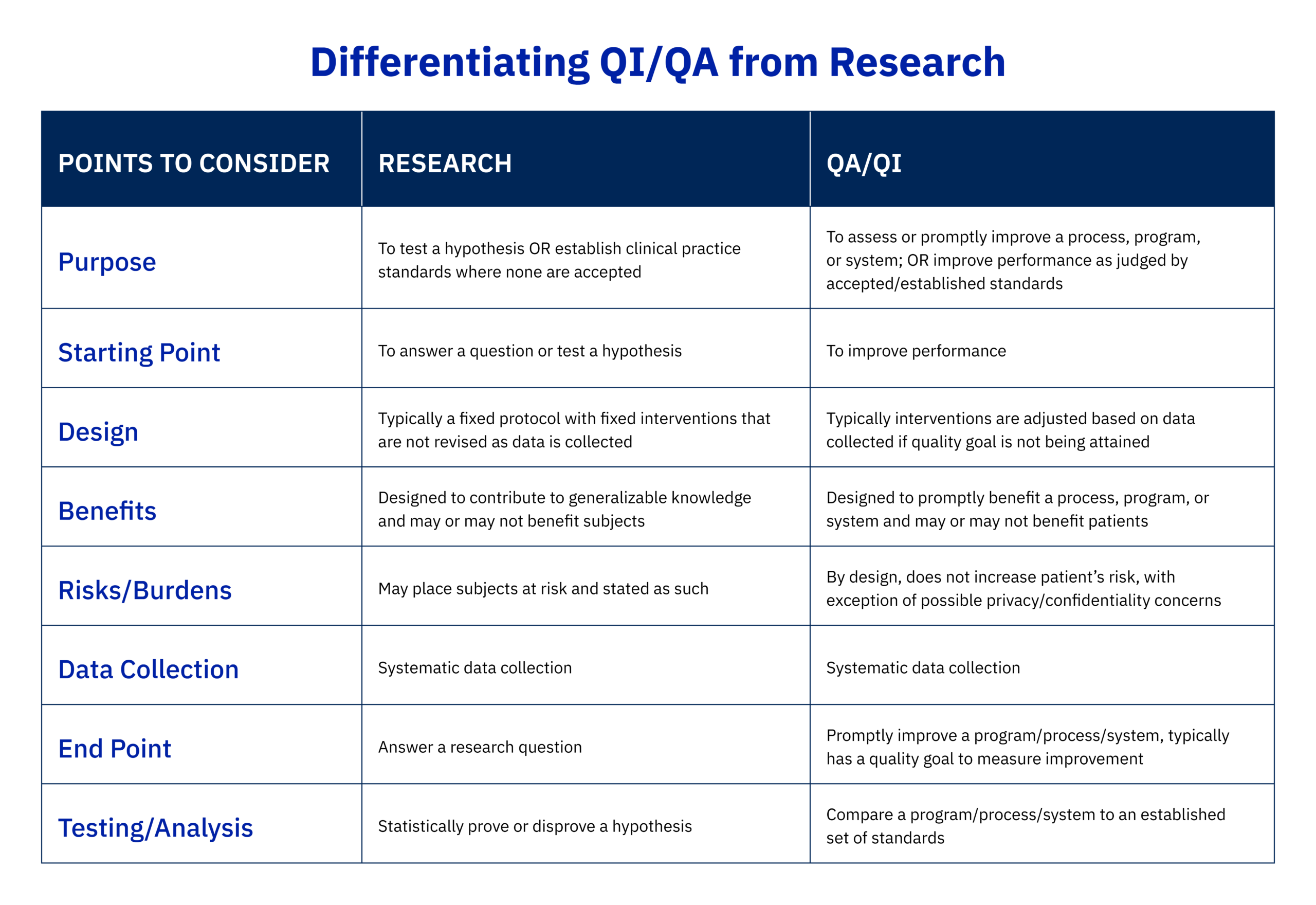
Download the QA/QI vs. Research Comparison Table
Features of the Comparison Table:
- Compares purpose, starting point, and design.
- Outlines differences in benefits and risks/burdens.
- Distinguishes between endpoints and analytical approaches.
Quality vs. Research from the UF IRB
The University of Florida Institutional Review Boards issued this policy brief to address frequently asked questions about the complex distinctions between QA/QI and research. Use it to understand the gray areas and determine if your project requires IRB consultation.
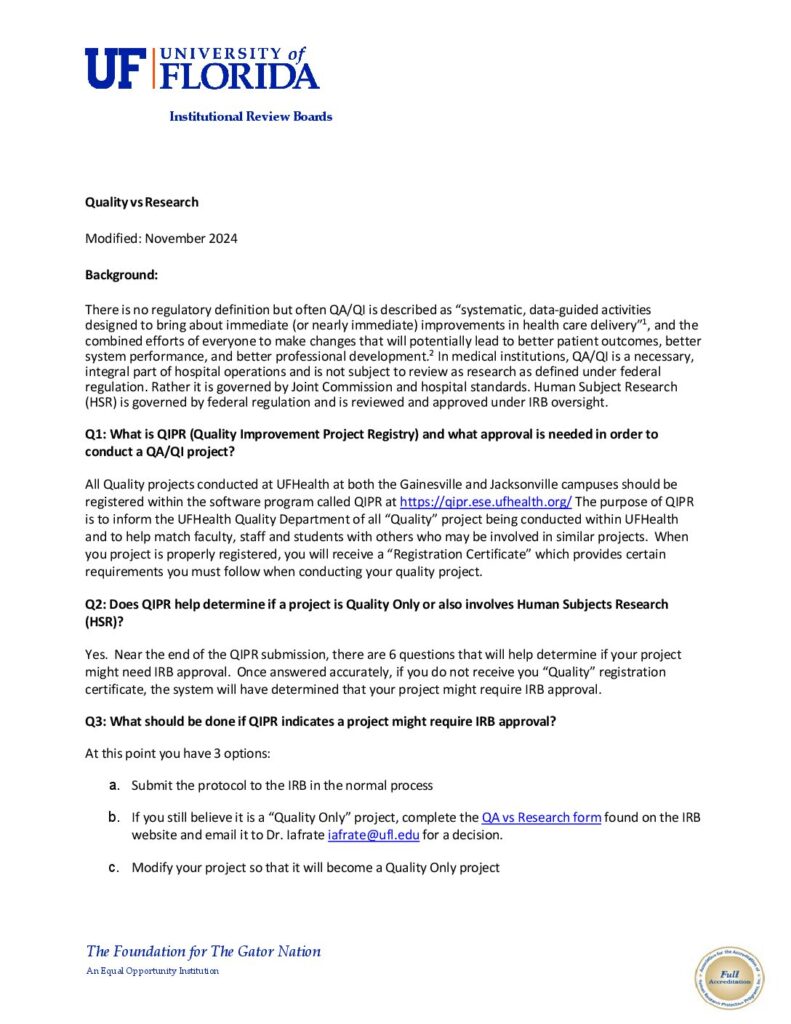
Download the Quality vs. Research Policy Brief
The Policy Brief Covers:
- Characteristics of projects that may be both QA/QI and research.
- The role of randomization in determining if a project is research.
- Whether the intent to publish makes a project research.
- How to handle journal requests for IRB approval for a QI project.