
 Liliana Bell, MHA, PMP
 What is The IHI Model for Improvement?
Embarking on a quality improvement project without a clear plan can feel like setting out on a trip without a map. The Institute for Healthcare Improvement (IHI) Model for Improvement provides that essential map. It is a simple yet powerful framework that helps teams structure their thinking, focus their efforts and move from a general problem to a specific, actionable plan.
The model is built on three fundamental questions that guide the entire planning process before any changes are tested.
These questions are:
- What are we trying to accomplish?
- How will we know that a change is an improvement? and
- What changes can we make that will result in improvement?
Answering the first question helps your team define a clear, concise and measurable aim—often in the form of a SMART goal. The second question pushes your team to identify the specific data and metrics you will use to track progress. The third question prompts a creative and systematic process of brainstorming and prioritizing interventions that will address the root causes of the problem.
By working through these questions, your team creates a project charter. This document serves as your shared roadmap, detailing your aim, measures and planned changes. It ensures everyone is aligned and provides a solid foundation before you begin testing your ideas on a small scale using Plan-Do-Study-Act (PDSA) cycles.
Resources
The resources below break down the IHI Model for Improvement into manageable parts. From understanding the core framework to diving deep into each of the three guiding questions, these videos and guide provide the practical knowledge you need to develop a comprehensive project charter and set your team up for success.
Introduction to the IHI Model Questions
Learn about the IHI Model for Improvement and its three fundamental questions that provide a roadmap for any QI project. This video explains how the model helps teams define their aim, measures and change ideas before beginning PDSA cycles.
Transcript: Introduction to the IHI Model Questions
Like planning any trip, having a map is important. Ensuring your team documents your plan will serve your team as you compare your plan to your eventual progress. The IHI model for improvement provides a roadmap for teams to focus their efforts and set meaningful goals.
At the heart of this model are three fundamental questions that guide the improvement process–
First, what are you trying to accomplish? Answering this question helps your team define a clear, measurable aim for your quality improvement efforts.
Second, how will you know a change is an improvement? Identifying the right metrics and measures is crucial to tracking your team’s progress.
And third, what changes can you make that will result in improvement? This question prompts you and your team to brainstorm ideas and interventions to test.
Once your team has answered these guiding questions, you next apply plan, do, study, act cycles, or PDSA cycles, for short to test changes on a small scale. Learn what works and scale successful strategies.
But for now, it is important that your team works through your roadmap and create a project charter. The IHI model can help your team do just that. Your team can systematically improve processes and deliver better patient outcomes by working through these steps.
The strength of the IHI model is its flexibility and simplicity. Whether your team is improving handoff communication, reducing delays in patient care, or enhancing documentation accuracy, the model provides a shared approach your team can rely on to drive improvement.
Model for Improvement Question 1: What Are You Trying to Accomplish?
Explore a deep dive into the first question of the IHI Model: “What are you trying to accomplish?” This guide walks through five key steps, from identifying the problem to defining your project scope and crafting a powerful SMART aim statement to guide your team.
Transcript: What Are You Trying to Accomplish?
The first question to consider when using the IHI model for improvement is, what are you trying to accomplish? Answering this question helps define a clear, measurable aim for your team’s quality improvement efforts.
Here’s how to do it in five steps. Identify the problem. Describe the project activities. Explain why improvement is needed. Describe the expected benefits. And finally, write a SMART aim statement.
Let’s look at each of these in turn. All teams notice care gaps or operational inefficiencies. Maybe your team has seen an increase in central line infections or a workflow that leads to missed follow-ups. These kinds of gaps in quality, service, and outcomes are exactly what quality improvement projects can help address.
Here, it is important to clearly identify the problem your team is trying to solve. Take time to discuss what’s not working well. Be specific. Defining the problem together ensures everyone understands the challenge and is committed to improving the situation.
Show the urgency behind your team’s project. This could include patient harm or safety risks, poor performance on clinical metrics, waste or inefficiencies in the process. Backing up the problem with evidence helps build support and secure the time, resources, and collaboration needed for successful change.
How will success look? Think about the impact on patients. For example, might the plan lead to fewer adverse events and better experiences? What about the impact on staff? Will they experience more efficient workflows leading to less frustration? Also, consider the impact on systems.
Maybe your team’s efforts will lead to reduced length of stay or improved documentation. Clarifying benefits help maintain motivation and communicates the clear value of the effort to stakeholders.
Crafting a SMART aim statement is a critical step. SMART aims concisely capture the specific, measurable, achievable, relevant, and time-bound nature of the quality improvement project. For example, consider the following goal. Reduce the medication error rate on the fifth floor medical surgical unit from 18% to 5% within the next six months.
This aim is specific. It targets a clear, measurable reduction in medication errors on the fifth floor medical surgical unit. It’s measurable. Why? It tracks the error rate through incident reports, medication audits, and staff feedback. The goal is achievable because the 72% reduction goal is ambitious yet realistic based on the planned interventions, including staff training and process adjustments.
Thinking about your team’s project, you should work to develop a SMART aim collaboratively with your team. Your team’s SMART aim will serve as its North Star to keep the project focused, unified, and manageable. The SMART aim will also enable your team to celebrate its progress towards your planned meaningful improvement.
Quality improvement projects include concrete actions to solve the identified problem. Your team might pilot a new rounding checklist, redesign a patient handoff form, or use visual reminders for time-sensitive meds.
Define who is involved, what the scope is, and where the changes will be tested. For example, if your project aims to reduce medication errors on a single hospital unit, in scope could include reviewing current prescription workflows, training nurses on a new checklist, and measuring error rates in that unit.
Out of scope might be changing the hospital’s electronic health record system, training staff from other units, or addressing errors related to medications given in the emergency department.
By being specific about what’s in and out of scope, you help your team focus on real, achievable changes and avoid getting sidetracked.
Importantly, ensure the project team includes diverse roles, those with authority to enact changes, technical experts with deep process knowledge, and frontline staff driving day-to-day operations. This cross-functional collaboration is the key to success.
Engaging stakeholders is vital to the success of any improvement project. Your team must identify who’s input or support is needed, and who will actively participate in testing changes.
Creating a stakeholder engagement plan ensures all key players are on board and committed to the project’s goals. Remember, quality improvement is a team sport. Each person plays a role in identifying problems, testing ideas, and celebrating wins that make care better for everyone.
Model for Improvement Question 2: How Will You Know if a Change is an Improvement?
Learn how to answer the second question: “How will you know a change is an improvement?” This video explains the importance of measurement and covers how to select an outcome, process and balancing measures, establish a baseline and plan your data collection.
Transcript: How Will You Know if a Change is an Improvement?
Accurate and meaningful measurement is the backbone of any successful improvement project — guiding your team from identifying issues to implementing solutions.
Why does measurement matter? Let’s think about it. Without data, you’re just making educated guesses. Measurement is the bridge between your team’s aim and the actual improvements you want to achieve.
It helps your team track progress and make informed decisions. Measurement prevents your team from relying on assumptions or opinions, leading to clearer insights and better outcomes. Remember, it’s crucial to track meaningful measures that drive learning, not just collect data for the sake of collecting data.
Good measurement includes multiple perspectives. Firstly, outcome measures help you understand what you aim to improve, such as adverse drug events or surgical site infections. Secondly, process measures help identify whether the individual steps or processes within the system are working as intended. Finally, balancing measures prevent the creation of undesirable side effects resulting from your team’s changes.
Establishing a baseline is crucial in any improvement project. Knowing your team’s current performance level gives you a reference point for comparison. Even gathering a small data sample provides a useful starting point.
Think of it as a snapshot of your current state, which you’ll use to compare before and after results. This comparison will help assess whether your changes have made a difference.
To effectively track progress, your team must plan how data will be gathered and tracked. Decide with your team where the data will come from and who will collect it. The key is to keep the process simple, clear, and consistent.
The easier it is to collect the data, the more likely your team is actually going to get it. Focus on what’s useable and avoid overcomplicating things. Finally, your team needs to consider how often it will collect data.
Frequency matters, but so does actually analyzing the data. So an important tip — don’t collect data more often than your team can actually review it. For most projects, weekly or biweekly measurements work well.
Identify who is responsible for tracking the data, and make it a team task to review it regularly. Ensuring clear responsibility and regular check-ins help maintain momentum and keeps everyone aligned with the project’s goals.
Remember that a clear project charter sets the foundation for aligning your team’s objectives and plans, so be sure to document, document, document.
Precise measurement transforms ideas into actionable insights, tracking progress and ensuring real improvements. Focus on meaningful metrics, establish baselines, define data collection methods, and set appropriate measurement frequencies.
These steps are really important for impactful change as they help you answer the question, how will you know if a change is an improvement?
Model for Improvement Question 3: What Changes Can You Make That Will Result in Improvement?
Discover how to answer the third question: “What changes can you make that will result in improvement?” Explore techniques for analyzing root causes, brainstorming change ideas, prioritizing your efforts and identifying potential barriers to success.
Transcript: What Changes Can You Make That Will Result in Improvement?
Let’s address a crucial question. What changes can you make that will result in improvement? To answer this, let’s explore root causes, generate ideas, and prioritize where to start in your quality improvement project.
The goal is to equip your team with practical strategies to guide effective change making. It’s essential to really understand the current process.
A thorough system analysis can help your team understand what’s happening. Your team can utilize tools like process mapping to visualize each step of the workflow, conduct observations, or hold interviews to gather insights from staff.
Tools like cause and effect, fishbone diagrams and driver diagrams can help your team pinpoint the root cause of issues. Often, the real issue hides behind an assumption or an invisible bottleneck.
Once your team understands the process, it’s time to generate change ideas. Start by brainstorming possible interventions, both proven strategies and new innovative approaches. Small tests of change allow your team to experiment without significant risk.
Engaging your team in this creative process can yield surprising and effective solutions. With a list of potential changes in hand, your team needs to rank them based on impact, feasibility, and cost.
This prioritization will help your team focus resources on the most promising ideas. Soon, your team will plan and execute an initial Plan-Do-Study-Act cycle to test these ideas on a small scale.
Take the time to outline your initial test plans. Anticipating potential barriers can help proactively address challenges and resistance. Discussing with your team what resistance may arise and brainstorming strategies to overcome these barriers is imperative.
Moreover, setting clear project boundaries is essential. It’s important to be honest about what’s in scope, and what’s not. This helps your team to avoid a situation where the project takes on too many disconnected tasks.
A focused scope helps the team stay aligned, maintain momentum, and deliver meaningful results. Remember that exploring root causes, generating change ideas, and prioritizing efforts are essential in driving successful improvement.
A well-crafted project charter, complete with thorough system analysis, proposed interventions, and clear scope will guide your team through effective and impactful changes. By answering the question, how will you know if a change is an improvement? Your team can achieve significant and lasting improvements in health care practices.
Concluding the Model for Improvement Questions: The Importance of a Project Charter
Understand how the answers to the three IHI Model questions come together to form a comprehensive project charter. This video explains why the charter is a critical roadmap that aligns your team before you begin testing changes with PDSA cycles.
Transcript: Concluding the Model for Improvement Questions: The Importance of a Project Charter
A project charter following the contours of the IHI model for improvement can be a powerful roadmap for change for your team. Before you move to the PDSA, or Plan-Do-Study-Act cycle,
your team should have a completed project charter. That charter answers three questions– what are you trying to accomplish? How will you know a change is an improvement? And three, what changes can you make
that will result in an improvement? Your charter helps your team understand the aims and background of your project, the scope and team membership, the plan for measurement, and the potential barriers your team may face.
Taking the time to complete this roadmap will guide your team for the important work of the PDSA cycles.
Project Charter Template
The Project Charter helps your team translate the answers to the IHI Model’s three questions into a comprehensive, actionable plan. This collaborative document serves as a roadmap to align your team, define the scope, and outline your strategy before you begin testing changes.
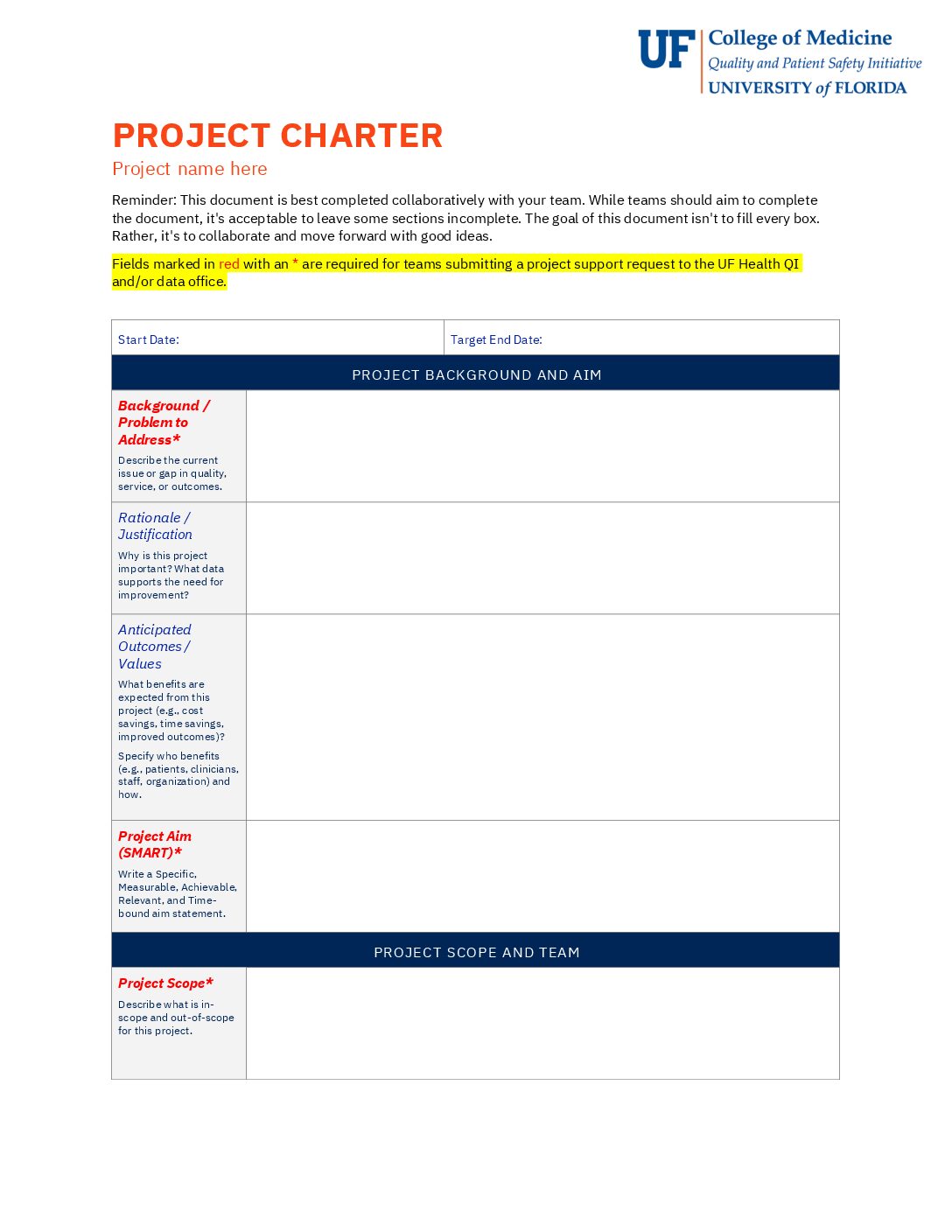
Download the Project Charter Template
Use this fillable template to create a comprehensive project charter for your QI project. It provides a structured format to document all essential components, including:
- A description of the problem, the project’s rationale, and a specific, measurable, achievable, relevant, and time-bound (SMART) aim statement.
- The principal outcome, process, and balancing measures to track progress and determine if a change is an improvement.
- A list of proposed change ideas, a summary of the root cause analysis, and an outline for the initial Plan-Do-Study-Act (PDSA) test cycles.
- Identification of potential barriers or risks, along with key project milestones and deadlines.