
 Liliana Bell, MHA, PMP
 What are SMART Goals?
Every successful quality improvement project begins with a clear destination. Broad objectives like “improve patient safety” or “reduce wait times” are good starting points, but they lack the specific, actionable direction a team needs to make progress.
Standing for Specific, Measurable, Achievable, Relevant, and Time-bound, it is a simple tool for turning broad aspirations into a focused “north star” that everyone on your team can rally behind. A SMART goal clarifies exactly what you want to accomplish, how you will measure success, and when you expect to achieve it. This eliminates ambiguity and provides the momentum needed to drive meaningful change.
Resources
The resources below provide clear examples and practical guidance to help you master the SMART framework. Use them to write effective aim statements that will set your own quality improvement projects up for success.
The Importance of Smart Goals (Infographic)
Use this downloadable infographic to learn the fundamentals of the SMART goal framework. It provides key questions for each component, breaks down a detailed clinical example of reducing readmissions, and outlines the benefits of creating clear, actionable goals.
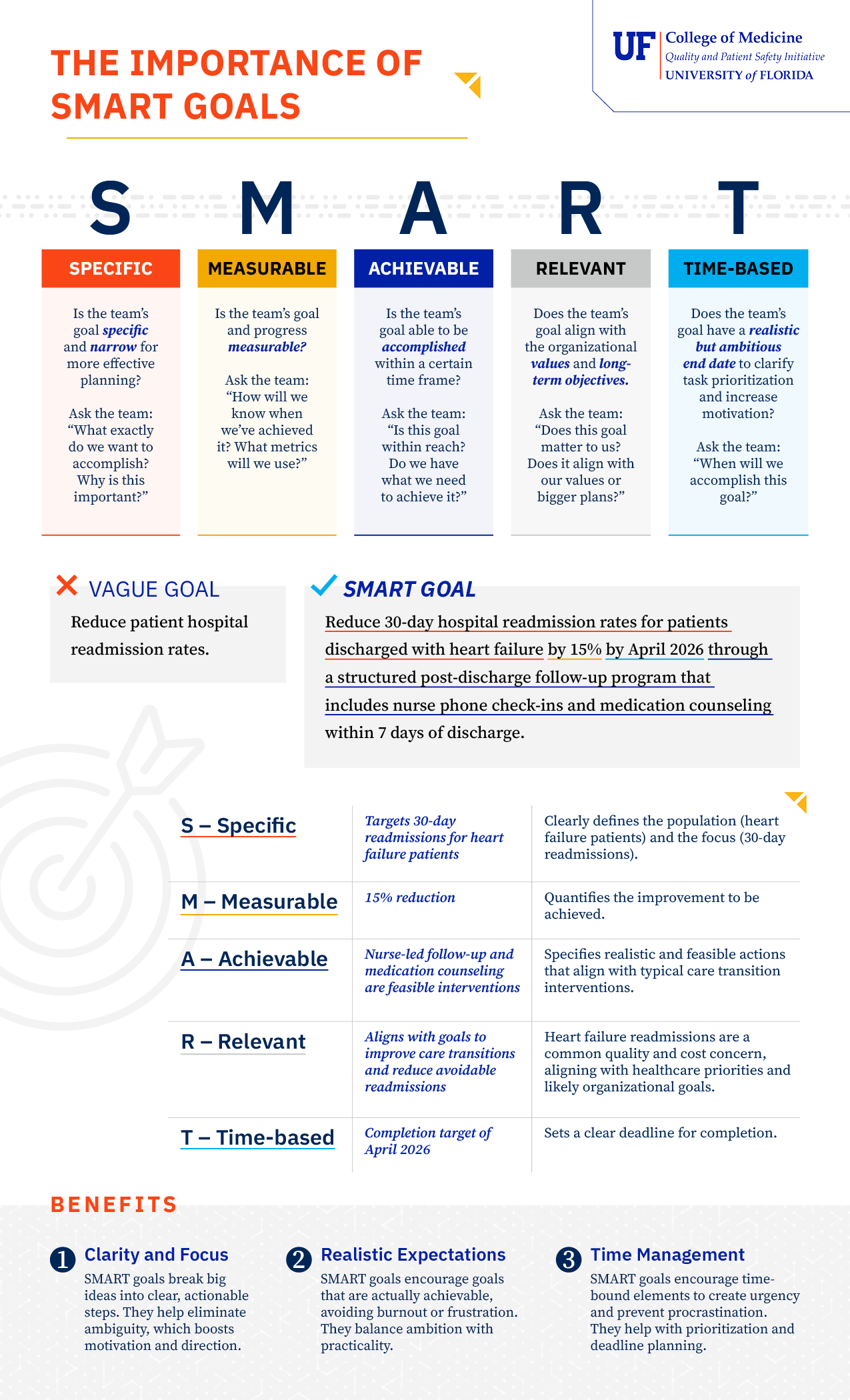
Visualize the Basics of SMART Goals
- The Core Framework: Understand why objectives must be Specific, Measurable, Achievable, Relevant, and Time-based.
- Strategic Advantages: Learn how SMART goals balance ambition with realistic limits to prevent burnout and improve time management.
- Real-World Application: See a detailed clinical example of reducing patient readmissions by assigning precise metrics, target populations, clear interventions, and strict deadlines.
SMART Goals (Video)
This video demonstrates how to craft a clear, measurable, and achievable goal for a quality improvement project. Learners will see how each element of a SMART aim applies in practice through a medication safety example.
Transcript: SMART Goals
SMART aims concisely capture the specific, measurable, achievable, relevant, and time-bound nature of the quality improvement project.
For example, consider the following goal. Reduce the medication error rate on the fifth floor medical surgical unit from 18% to 5% within the next six months.
This aim is specific. How? It targets a clear, measurable reduction in medication errors on the fifth floor medical surgical unit.
It’s measurable. Why? It tracks the error rate through incident reports, medication audits, and staff feedback.
The goal is achievable because the 72% reduction goal is ambitious yet realistic based on the planned interventions, including staff training and process improvements.
It’s relevant because improving medication safety directly aligns with the organizational priorities of patient safety and quality care.
Finally, it’s time-bound. There is a six-month timeline to accomplish this goal, allowing for sufficient time for implementation, monitoring, and adjustments.