
 Pouya Ameli, MD, MS
  Naveen Baskaran, MD
  Brian Lobo, MD
 Leveraging the EHR for Quality Improvement
The Electronic Health Record is far more than a digital chart; it is a dynamic environment for driving meaningful quality improvement. Leveraging it effectively involves two key activities: exploring data to identify opportunities and implementing tools to create solutions. Both of these activities must be guided by a strong ethical framework that protects patient privacy and ensures data is used responsibly.
Powerful self-service analytics tools, such as SlicerDicer, empower clinicians to ask direct questions of their own clinical data. This allows teams to identify trends and uncover patient safety issues or workflow inefficiencies that may not be obvious on the surface. This data exploration is often the critical first step that informs a focused and impactful QI project.
Once an opportunity is identified, the EHR offers a platform for clinician-led innovation. As demonstrated in the case study on improving neurology transfers, a motivated physician can work with frontline users to build and implement highly effective tools—like a “smart phrase” for handoffs—without needing a formal IT project. This approach, grounded in the principles of clinical informatics, ensures that solutions are practical, efficient and seamlessly integrated into the daily workflow, leading to safer and more reliable patient care.
Resources
The following resources provide real-world examples and practical tools to help you apply quality improvement principles using your EHR. They demonstrate how to move from theory to action by standardizing workflows, analyzing data, and using EHR tools to support clinical decision-making.
Understand the Basics of Clinical Informatics and Data
Before implementing solutions, it is critical to understand the intersection of medicine and technology, as well as the ethical principles of using clinical data.
Clinical Informatics: The EHR
Learn the fundamentals of clinical informatics and how it serves as a bridge between medicine and technology. This video explains the “three pillars”—people, process and technology—and the “five rights” of clinical decision support, providing a framework for optimizing the EHR to improve workflows and patient outcomes.
Transcript: Clinical Informatics: The EHR
An Electronic Health Record system, or EHR, is a powerful tool for providers. The field of clinical informatics can help us further optimize EHR systems. This can significantly enhance patient care, quality, and safety.
Clinical informatics is a field that merges technology and data to improve patient care, streamline healthcare workflows, and enhance decision-making processes. In essence, it serves as a bridge between medicine and technology.
The three key pillars of clinical informatics are people, process, and technology.
People refers to the end users. This group includes nurses, physicians, advanced practice providers, allied health professionals, care coordinators, IT team members, administrators, and other frontline and support staff who contribute to delivering safe and effective care.
Process represents the workflows, policies, and procedures that ensure effective healthcare delivery.
Finally, technology encompasses the tools and systems, such as EHRs and decision support systems, that aid in our day-to-day clinical operations.
Central to clinical informatics is the patient and provider-first model. By optimizing provider workflows in decision-making processes, we can deliver higher-quality care.
A crucial aspect of this is clinical decision support. An effective EHR provides the best clinical decision support by delivering the right information, which is evidence-based and pertinent to the circumstance, to the right person.
This information appears in the right format, whether an alert, order, or reference information, through the right channel, such as the electronic medical record or mobile device, exactly at the right time in the workflow when decisions or actions are needed.
Physician builders play a crucial role in creating effective EHR systems that support better clinical decision-making and, ultimately, better patient outcomes.
Specialties with dedicated builders often perform better. Physician builders can help design intuitive, easy-to-use order sets that improve patient outcomes.
In short, understanding the essentials of clinical informatics can enable you to better use and refine EHR systems.
Data Considerations when Using EHR/CDS Tools for QI
Brian Lobo, M.D., rhinology, sinus and skull base surgeon, helps you to understand the roles of EHR and CDS in standardizing healthcare processes. Learn the difference between a QI initiative and a research project, and articulate the importance of this distinction. Finally, Dr. Lobo explains why knowing the source, collection method, and context of data is critical for its effective use in a QI project.
Transcript: Data Considerations when Using EHR/CDS Tools for QI
So EHR refers to the Electronic Health Record, which is a general term for medical records. CDS is Clinical Decision Support, which
is the use of assistive tools, not AI, which is a huge buzzword now, but any real assistive tools in the electronic health record to guide a physician or a care provider in judgment. In terms of value, the EHR and CDS
allow for us to provide standardization, standardized process, and most importantly, repeatability with respect to how we guide people to do specific tasks. The biggest concern, or the biggest responsibility, has to do with truly acknowledging whether what
one is doing is QI or research. Those are completely separate things, and one has to acknowledge the fact that research is often hidden in QI initiatives or covered as a QI initiative.
Those really need to be separated. What’s also important to remember is that patient data, the composite patient data that exists in the electronic health record or in our research composite analogs, is not an ocean to be fished with a giant net.
Quality improvement needs to target specific functions and specific problems in specific areas. Data can then be used to justify or to augment what is being done in a quality initiative, but data is often the last step that’s
required when identifying these sort of problems. The most important advice I have is to consider where data falls in the pyramid of how data is organized. If you think of data as the base of the pyramid, you have data, information, knowledge, and wisdom.
Those are iterative building blocks. In QI, QI tends to fall more in the knowledge and wisdom category and uses data as a foundational building block to expand the QI initiatives.
That is to say, if you figure out an amazing process in the operating room to provide standardization, you can then see if the knowledge and wisdom gained from that applies to other data.
But you don’t really want to use the data to force knowledge and wisdom in other places. The other important point about data is understanding how data is collected. There’s a famous story about Jeffrey Bezos being
told that hold times at Amazon were less than 1 minute, and Jeffrey Bezos didn’t believe it. So he simply picked up the phone and called the Amazon support line. As him and everyone in the meeting
proceeded to sit on hold, they quickly realized that the data being collected wasn’t accurate. Understanding the source of your data and how your data is collected is extraordinarily important. If you looked at a picture as though you were a dog
and you were missing one of the cones in your retina so you couldn’t see a third of the color spectrum, you’d have a complete misunderstanding of what a picture looked like.
Conversely, if you were a bird and had more of the color spectrum, you’d see a completely different outcome. Understanding what the data actually represents and how it was collected is incredibly important when considering how to use data in a QI project
and how to collect that data.
Standardize Processes with EHR Templates and Smart Tools
One of the most effective QI strategies is reducing unwanted variation in care. The EHR can be a powerful ally in this effort through the use of templates, smart phrases, and standardized notes that ensure critical information is captured consistently.
Case Study Video: Enhancing Patient Safety in Neurology Transfers through a Collaborative, Standardized Handoff Tool
Watch a narrative overview of how a neurology team addressed a critical patient safety risk by creating a standardized transfer note in the EHR. In this video, Pouya Ameli, M.D., M.S., assistant professor of neurology and neurosurgery, highlights the importance of capturing nuanced clinical decision-making and using anticipatory guidance to prevent adverse events, showcasing a model for rapid, clinician-led innovation.
Transcript: Enhancing Patient Safety in Neurology Transfers through a Collaborative, Standardized Handoff Tool
The field of neurology faces a nationwide provider shortage, creating immense pressure on academic medical centers to increase patient access.
In response, our institution restructured its services to open a new access clinic. While successful, this change introduced a new and serious patient safety risk– the general neurology team no longer followed their patients in the neuro ICU, as the team was busy staffing the new access clinic.
Having the team not follow patients in the ICU was a way to decrease their workload as they facilitated the new clinic. However, the change created a critical information gap during patient transfers that could compromise care.
This case study is an example of what can be done within an EHR by a single clinician or small team, without needing to consult IT to create an EHR build.
The project was led by a physician champion. It was built around the frontline clinicians who would use the tool every day– neurology residents and advanced practice providers.
Recognizing that a verbal-only handoff was insufficient, the group decided that a standardized written note embedded within the electronic health record was the most effective strategy to ensure clear, consistent, and accessible communication for the entire care team.
The centerpiece of their strategy was the creation of a single comprehensive transfer note.
This bidirectional tool, built as an EHR smart phrase, was designed to function as a definitive handoff document for patients moving between the ICU and the general neurology floor.
The tool prompted clinicians to document information that is frequently lost in transfers, but is critical for patient safety. It captured not just what was done, but why, detailing the nuanced decision-making behind complex medication choices for conditions like status epilepticus or autoimmune encephalitis.
A key feature was the explicit documentation of failed therapies. By clearly stating, for example, that a seizure medication like Keppra had already been tried and was ineffective, the note prevents the receiving team from losing valuable time by reinventing the wheel.
The note also provided crucial anticipatory guidance. It highlighted ongoing risks such as a tenuous respiratory status requiring careful airway management, ensuring the receiving team was fully aware of the patient’s vulnerabilities and could tailor their care plan accordingly.
The results, though qualitative, were immediate and clear. The standardized note streamlined communication for a team of over 40 clinicians. Clinicians reported a significant reduction in patients bouncing back to the ICU for preventable complications like aspiration– a direct validation of the more effective and complete handoff process.
Beyond the immediate safety improvement, the initiative showcased a powerful new model for quality improvement– rapid, clinician-led innovation.
By building the tool himself within the existing EHR framework, the physician champion was able to bypass traditional IT development cycles, proving that empowered clinicians can create and implement effective solutions with speed and precision.
This case study underscores a fundamental principle in modern healthcare. That strategic collaboration with frontline users, combined with the intelligent integration of existing technology, can systematically enhance patient safety and create more resilient clinical workflows.
Case Study: Enhancing Patient Safety in Neurology Transfers through a Collaborative, Standardized Handoff Tool
This case study details how a clinician-led team addressed a high-risk communication gap during patient transfers between the Neuro ICU and the general neurology service. To ensure safer handoffs, the team developed a standardized transfer note directly within the EHR by building a “smart phrase” and “smart list.” This approach allowed for rapid development and deployment without relying on formal IT project cycles. By involving residents and APPs in the design process, the team created a practical tool that improved communication for over 40 clinicians and led to a marked decrease in preventable adverse events and ICU “bounce-backs.” The project highlights how motivated clinicians can leverage existing EHR functionality to quickly and effectively improve patient safety.
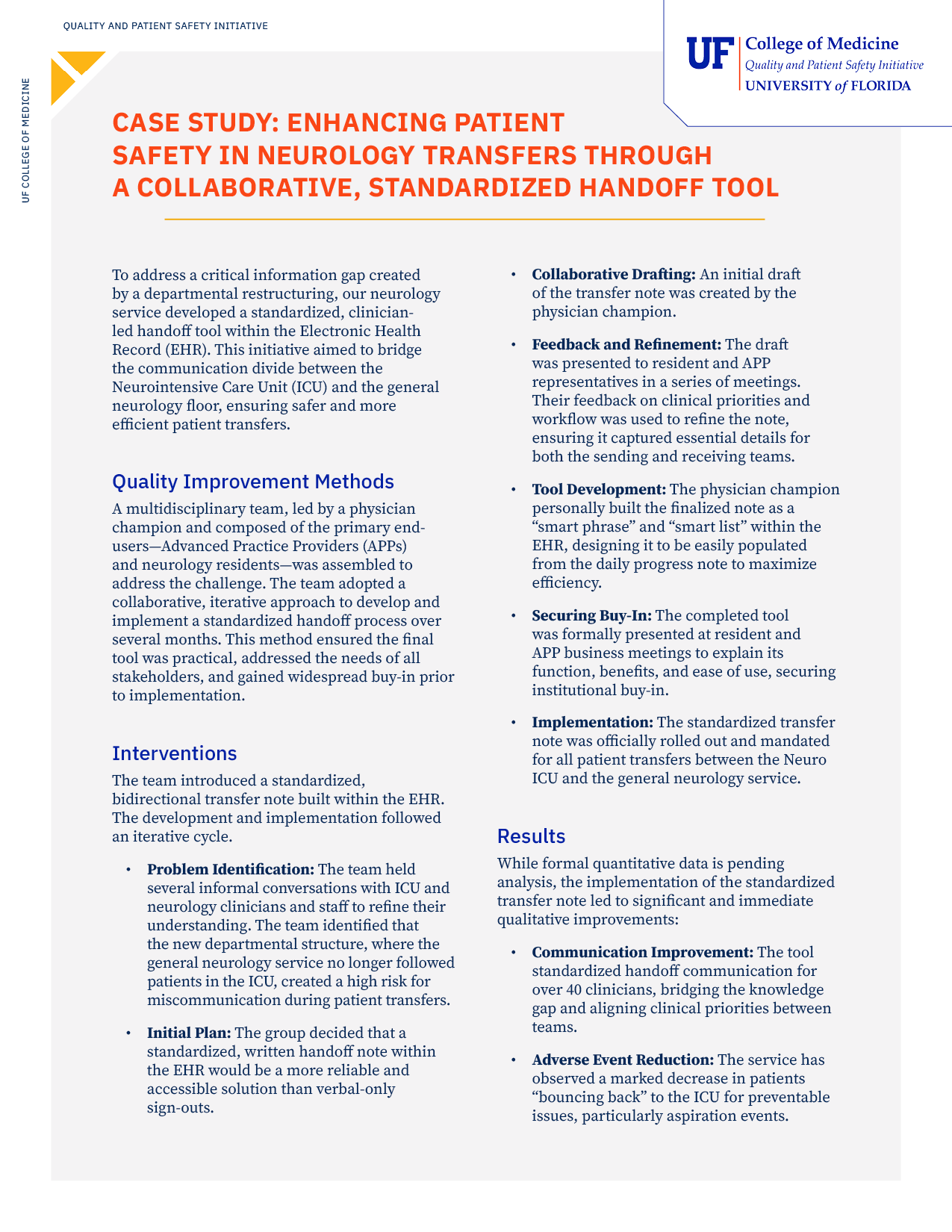
Explore the Neurology Transfer Patient Safety Case Study
Key takeaways of the case study:
- Clinicians can rapidly build and implement solutions using existing EHR tools, bypassing formal IT cycles.
- Involving frontline end-users in the design process ensures practical tools and widespread buy-in.
- Seamless integration into existing clinical workflows is crucial for adoption and sustained use.
- Standardizing EHR handoffs enhances patient safety by keeping critical information accessible to the care team.