
 Juan Munoz Pena, MD
  Stephen Lemon, PharmD
  Brooks Morgan
 What are Quality Scorecards?
In healthcare, how do we know if a change is truly an improvement? Quality scorecards are data tools that help answer this question. Used by hospitals nationwide, scorecards from vendors like Vizient, Leapfrog, and CMS track performance across critical areas of care, including mortality rates, patient safety incidents, readmissions, and efficiency. They provide a clear, data-driven look at how well an institution is caring for its patients and where opportunities for improvement exist.
These data are a powerful guide for strategic quality improvement. They allow clinical teams to see how they perform relative to peer institutions and pinpoint specific areas that need attention. As demonstrated in UF Health case studies on improving hypoglycemia and warfarin management, a focused QI project aimed at a specific care process can lead to significant enhancements in patient safety, which in turn drives measurable improvements in scorecard rankings and national standing.
However, the most important takeaway is that the goal isn’t simply to “fix the metric.” Scorecards are a reflection of care, not the purpose of it. The true focus must always be on delivering the highest quality, most compassionate, patient-centered care every single day. When we prioritize our patients and the excellence of our clinical practice, improved metrics will naturally follow.
Resources
The resources below provide a clear introduction to healthcare quality scorecards and showcase real-world examples of how data-driven quality improvement can lead to meaningful results for both patients and performance metrics.
Introduction to Scorecards
Learn what quality scorecards are and how they are used to measure hospital performance across key areas like safety, efficiency, and patient experience. This video explains why the true focus of any QI initiative should be on improving patient care, which will, in turn, lead to better metrics.
Transcript: Introduction to Scorecards
The US spends billions annually on quality reporting and health care.
Why is so much money spent on measuring hospital quality?
Because measures are necessary to understand impacts on patient care and safety.
For hospitals and clinical teams, understanding performance is crucial for improvement.
And that there are different scorecards often used internally by member hospitals.
These pull together essential data across key areas of care.
Examples include mortality rates, safety incidents, how often patients are readmitted, efficiency metrics like length of stay, patient experiences based on surveys, and even how equitably care is delivered.
Examples of scorecards include Vizient, Leapfrog, CMS, and others.
This data isn’t just numbers; it’s a powerful guide.
It helps clinical teams and hospitals see their performance relative to their peers, pinpoint areas that need attention, and strategically plan their quality improvement efforts.
It shows them where they stand and points the way forward for better care.
But here’s the critical takeaway—while these metrics guide us, our goal isn’t just to fix the metric.
The true focus must always be on delivering the highest quality, patient-centered care every single day.
But when we prioritize excellent, compassionate care for our patients, the improved metrics will naturally follow.
It’s about the patient first.
And the scorecard reflects that dedication.
Hypoglycemia Case Study
Case Study: Hypoglycemia Quality Improvement Project (Video)
Explore a case study on a successful quality improvement project aimed at reducing hypoglycemic events in hospitalized patients. This video details the interventions used, including the Triad Process and PDSA cycles, and demonstrates how these efforts improved patient safety and the hospital’s Vizient score.
Transcript: Hypoglycemia Quality Improvement Project
The hypoglycemia quality improvement project aimed to reduce hypoglycemic events among inpatients and enhance patient safety and care quality. Reducing hypoglycemia is essential to ensure patient safety, as hypoglycemia can lead to serious complications such as seizures, falls, and even death. Reducing hypoglycemia improves clinical outcomes by reducing hospital stays, complications, and readmission rates, while also enhancing the patient experience and trust in care.
Additionally, hypoglycemia is a key quality and safety metric tracked by regulatory bodies, impacting hospital ratings and reimbursement. Preventing it aligns with both ethical responsibilities and standard for high‑quality care. Reflecting a commitment to high standards of patient care, the primary aim was to achieve a 20 % reduction in the number of hospitalized adult patients with blood glucose levels below 50 mg/dL after receiving insulin that day or the day prior.
This goal was achieved in two years. The project employed the Plan‑Do‑Study‑Act, PDSA cycles, which facilitated continuous improvement through repeated testing and refinement of interventions. Monthly meetings were conducted to review individual cases of hypoglycemia, identify root causes, and discuss potential improvements.
Several key changes were implemented, including the triad process, which synchronizes food delivery, glucose monitoring, and insulin administration. Reducing basal insulin dose by 20 % was the initial attempt, but weight‑based insulin dosing as an alternative was more effective in reducing hypoglycemia events. Clinicians also developed standardized care sets for patients with type 1 and type 2 diabetes, chronic kidney disease, and those insulin‑naïve.
Clinicians conducted regular audits and monthly case reviews to identify areas of opportunity and assess both hypoglycemia incidence and adherence to new protocols. Data monitoring and visualization were integral to the project. A run chart was used to track the timing of interventions and corresponding changes in hypoglycemia rates, allowing clinicians to evaluate their effectiveness over time.
All told, the project successfully achieved a measurable reduction in hypoglycemic events, significantly improving our Vizient score and demonstrating enhanced patient safety and quality care. This project underscores the importance of strategic planning, continuous monitoring, and multidisciplinary collaboration in improving patient care.
Hypoglycemia Reduction Case Study (Download)
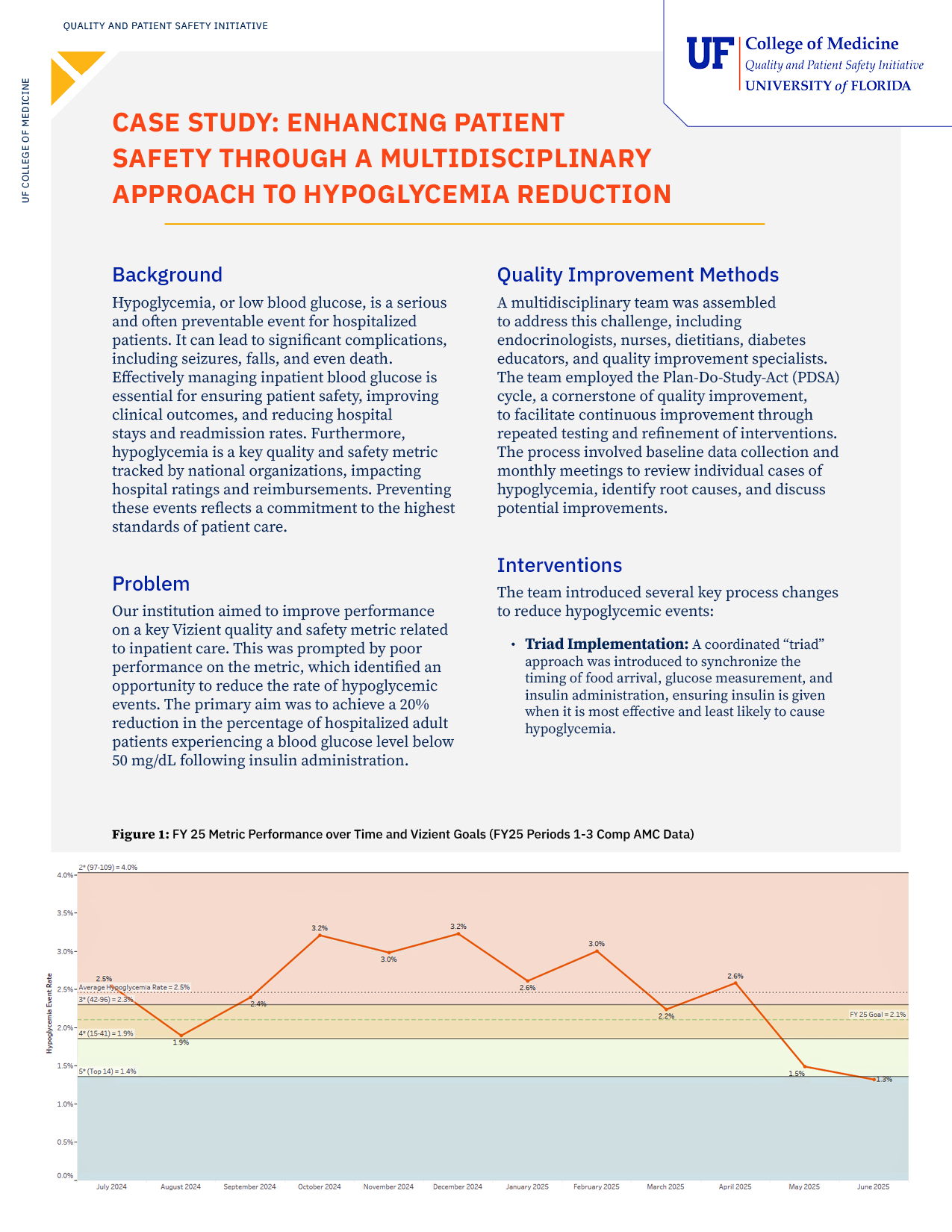
This initiative aimed to reduce the percentage of hospitalized adult patients experiencing a blood glucose level below 50 mg/dL after receiving insulin. A downloadable PDF summary of the case study is provided below.
Download the Hypoglyclemia Case Study
A multidisciplinary team utilized Plan-Do-Study-Act (PDSA) cycles to implement several key interventions:
- Triad Implementation: Synchronized the timing of food arrival, glucose measurement, and insulin administration to maximize efficacy and minimize risks.
- Standardized Dosing and Targets: Implemented weight-based insulin dosing and established moderate inpatient glucose targets (140–180 mg/dL) based on ADA standards.
- Results: The project successfully reduced the rate of severe hypoglycemic events and positively impacted the hospital’s Vizient safety scores.
Warfarin Case Study
Improving Warfarin Management (Video)
This video highlights the use of technology-enabled interventions, such as EHR tools and automated alerts, to systematically reduce high INR incidents and enhance patient safety.
Transcript: Improving Warfarin Management through Multidisciplinary Collaboration and PDSA Cycles
Warfarin is a widely used anticoagulant that requires meticulous monitoring to balance its therapeutic benefits against the risks of bleeding and stroke.
An International Normalized Ratio, or INR, greater than 5 after more than three doses of warfarin is considered unsafe and preventable.
Recognizing the delicate balance required in anticoagulation treatment, a team at UF Health set an ambitious goal of achieving a five‑star Vizient INR‑based metric rating by reducing high INR incidents to less than 2 % of patient cases.
The team’s approach was methodical and strategic, leveraging the Plan‑Do‑Study‑Act, or PDSA cycle, as their primary framework for quality improvement, comprising pharmacists, physician champions, nurses, and administrative sponsors.
The multidisciplinary group recognized that addressing warfarin management required a comprehensive, technology‑enabled intervention strategy.
Their systematic approach focused on multiple critical intervention points.
A key strategy involved implementing an INR threshold protocol, where warfarin would be automatically held if the INR exceeded 3.5.
The team developed sophisticated electronic health record tools designed to proactively identify patients with rapidly escalating INR levels and potential drug interactions.
Automatic dispensing cabinet alerts were configured to notify health care providers of elevated INR levels before medication administration.
A dedicated patient risk report was generated to identify individuals at potential risk of meeting high INR metrics.
Daily INR monitoring became a mandated protocol, ensuring timely and precise dosage adjustments.
The dose adjustment protocol was particularly nuanced when an INR exceeded 2.5 and increased by more than 0.6 within 24 hours.
The team’s protocol mandated holding the warfarin dose and reducing the weekly dosage by 50 %, demonstrating a calculated and conservative approach to patient safety.
The results were compelling.
Performance on the warfarin INR metric improved by 55.2 % with the institution’s peer ranking surging by an impressive 89.4 %.
This sustained improvement validated the team’s methodical approach and highlighted the potential of technology‑enabled multidisciplinary clinical interventions.
Beyond the immediate outcomes, the initiative showcased the scalability of their anticoagulation management model.
The strategies developed held potential for adaptation across various high‑risk patient populations, representing a significant advancement in clinical quality improvement methodologies.
The case study underscored a fundamental principle in modern health care—that strategic collaboration, technology integration, and iterative improvement can systematically enhance patient safety and clinical outcomes.
Warfarin Management Case Study (Download)
This project focused on improving INR-based metrics, which requires that less than 2% of patients have an International Normalized Ratio (INR) greater than 5. A downloadable PDF summary of the case study is provided below.

Download the Warfarin Case Study
Over a 24-month period encompassing 5 PDSA cycles, the team implemented a series of escalating interventions:
- Technology-Enabled Monitoring: Developed an electronic health record (EHR) tool that served as a single source of truth, implemented Omnicell alerts for high INRs, and created daily patient risk reports for pharmacists.
- Standardized Protocols: Mandated daily INR monitoring, created a specific dose adjustment protocol for rapidly rising INRs, and added placeholder EHR orders to standardize the process of withholding warfarin.
- Results: The initiative achieved a 55.2% improvement in metric performance and an 89.4% improvement in the institution’s peer ranking.